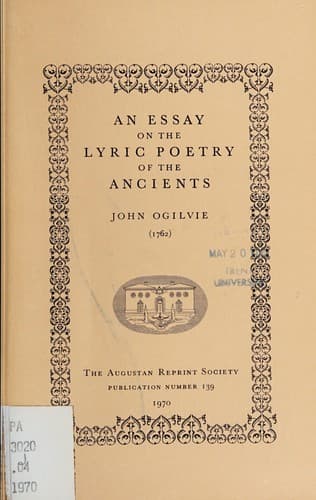
An Essay on the Lyric Poetry of the AncientsOgilvie, John
History
An Essay on the Lyric Poetry of the Ancients
Ogilvie, John
Classical poetry -- History and criticism
From this simple and impartial view of the Lyric Poetry of the Ancients,
considered as one branch of a cultivated Art, your Lordship will perhaps
be inclined to conclude, that in the Arts, as in the characters of men,
those which are susceptible of the highest excellence, are likewise
frequently marked with the most striking defects. This mixture of beauty
and deformity, of grandeur and meanness, which enters so often into the
action as well as the speculation of mankind, ought to be considered as
the characteristic of the human mind, which in the chimerical pursuit of
perfection is hurried by its own impetuosity from one extreme to
another. Your Lordship has, no doubt, frequently observed, that there is
upon the whole a greater uniformity in the characters of men than
superficial enquiry would lead us to conceive. A temptation operating
forcibly on the ruling passion will produce in a temper naturally gentle
and equal, an irregularity as remarkable, and sometimes carried to a
greater length, than the most powerful stimulus is able to excite in a
man of warm passions, and florid imagination. This is a fact, of which
experience will suggest examples to every person who is conversant with
mankind.
We ought not therefore to wonder, when we observe in the writings of a
Great Genius beauties and blemishes blended promiscuously, and when we
find the Poet’s imagination distinguished only by those marks of
inaccuracy which appear in the actions of others, and which are
ultimately to be derived from the complicated ingredients of the human
mind.
I have been led into this train of reflection, as it will enable us to
account for the inequalities which are to be met with in the writings of
Pindar, exposed as they have been to the admiration, and to the censure
of posterity. Whatever propriety the preceding rules may have with
regard to Lyric Poetry, it is certain that this Poet is not the standard
from whose work they are deduced. We have already seen that He himself
disclaims all conformity to the shackles of method, and that he insists
upon the privilege of giving a loose rein to the excursions of
imagination. The consequences of this proceeding are eminently
conspicuous in every part of his writings. His composition is coloured
with that rich imagery which Fancy throws upon the coldest sentiments,
his digressions are often too frequent and but remotely connected with
the principal subject, his personifications are bold and exuberant, and
he has made as free an use of theological fable as any Poet among the
Ancients.
Public-domain text, read in full here on John Shaqi.
Reviews
Reviews
No reviews yet
Be the first to share your thoughts on this work.
Join the Discussion
Join the discussion
Sign in to leave a comment or review.
Sign InorCreate an account