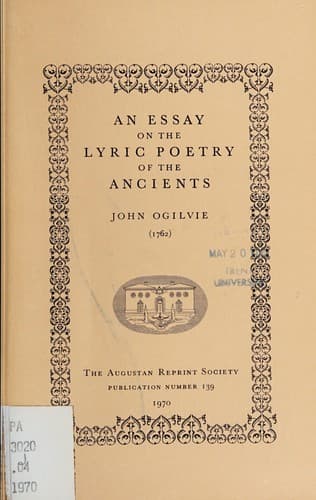
An Essay on the Lyric Poetry of the AncientsOgilvie, John
History
An Essay on the Lyric Poetry of the Ancients
Ogilvie, John
Classical poetry -- History and criticism
After all however we must acknowledge, that Pindar has rendered his
pieces obscure on many occasions by giving too much scope to a wild
imagination; and perhaps the true reason for which he took this liberty
was that he _imitated the example of his Predecessors_. He had seen the
first Lyric Poets indulging the boldest sallies of Fancy, and applying
to particular purposes the Mythology of their country; and as their
writings had been held in admiration by succeeding ages, instead of
being exposed to the researches of criticism, he was encouraged to
proceed in the same course, by the expectation of obtaining a similar
reward. From a passage formerly quoted, it would appear that Pindar
thought himself peculiarly exempted from conforming to rules of any kind
whatever[87], and we can suppose this opinion to have proceeded
originally from no other foundation than his knowledge of the practice
of former authors.
[Footnote 87: Vide supra, p. 57.]
I am sufficiently aware, my Lord, that some readers may object to the
preceding theory, that it is probable, if Pindar had been of opinion
that Lyric Poetry in his time stood in need of material emendations, the
same fertility of invention which enabled him to reach the heighth of
excellence in this art, without however altering its original
principles; that this would have led him likewise to invent new rules,
and to supply the deficiencies of his Predecessors. I will venture to
affirm, that this is the only species of invention, in which we have
seldom reason to expect that an Original Genius will attempt to excel.
It hath often been observed, that the earliest productions of a Great
Genius are generally the most remarkable for wildness and inequality.
A sublime imagination is always reaching at something great and
astonishing. Sometimes it seizeth the object of its pursuit, and at
others, like a person dizzy with the heighth of his station, it staggers
and falls headlong. When the mind of such a person ripens, and his
judgment arrives at its full maturity, we have reason to expect that the
strain of his competition will be more confident and masterly; but his
imagination, cramped by the rules which have been formerly laid down,
will be still desirous of _breaking_ the _old fetters_, rather than
felicitous of _inventing new ones_. Though therefore it must be
acknowledged that the same Faculty which is able to invent characters,
and to _colour_ sentiment may likewise discover the rules and principles
of an Art, yet we have no ground to hope that it will often be employed
to effectuate a purpose which an Author may consider as in some measure
prejudicial.
Public-domain text, read in full here on John Shaqi.
Reviews
Reviews
No reviews yet
Be the first to share your thoughts on this work.
Join the Discussion
Join the discussion
Sign in to leave a comment or review.
Sign InorCreate an account