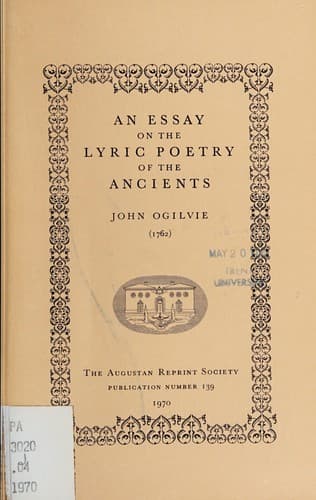
An Essay on the Lyric Poetry of the AncientsOgilvie, John
History
An Essay on the Lyric Poetry of the Ancients
Ogilvie, John
Classical poetry -- History and criticism
To compensate for the blemishes formerly mentioned, the writings of
Pindar abound with the most instructive moral sentiments, as well as
with the most exquisite beauties of descriptive poetry. The Poet often
throws in a reflection of this kind in the most natural manner, as it
seems to arise spontaneously from the subject. Thus he prepares the mind
to hear of the catastrophe of Tlepolemus by an exclamation perfectly
apposite, and appropriated to the occasion.
Αμφι δ’ ανδρω-
πων φρεσιν αμπλακιαι
Αναριθμητοι κρεμανται
τουτο δ’ αμηκανον εὑρειν
Ὁτι νυν, και εν τελευ-
τα φερτατον ανδρε τυχειν. Pin. Olym. VII.
But wrapt in error is the human mind,
And human bliss is ever insecure;
Know we what fortune yet remains behind?
Know we how long the present shall endure? WEST.
This method of introducing moral observations adds peculiar dignity and
importance to Lyric Poetry, and is likewise happily suited to the Ode,
whose diversified composition naturally admits of it.
I shall only observe further with regard to Pindar, that his character
is eminently distinguished by that noble superiority to vulgar opinions,
which is the inseparable concomitant of true genius. He appears to have
had his Zoilus as well as Homer, and to have been equally fallible of
the extent and sublimity of his own talents. Thus he compares his
enemies to a parcel of crows and magpies pursuing an eagle.
The learned Abbe Fraquier in a short dissertation on the character of
Pindar affirms, that one will discover too obvious an imitation of this
Poet in those pieces of Horace which are sublime and diversified[88]. He
mentions, as examples of this, his celebrated Odes to Virgil[89] and to
Galatea[90], intended to dissuade them from going to sea; and that in
which he so artfully represents to the Roman people the danger and
impropriety of removing the seat of the Empire to Troy[91]. Upon
comparing these with the Odes of Pindar, he says that we shall find more
strength, more energy, and more sublimity in the works of the Greek,
than in those of the Roman Poet[92]. In the three Odes formerly
mentioned, he observes that the digressions never lead us far from the
principal subject, and the Poet’s imagination appears to be too much
confined to one place. On the contrary, Pindar never curbs the
exuberance of his Genius. He celebrates promiscuously in the same Ode,
Gods, Heroes, and persons who have made a shining figure in their age
and country, by imitating illustrious examples[93].
[Footnote 88: Ce son des tableaux d’un Eleve habile, ou l’on
reconnoit la maniere du Maitre, bien qu’ on n’y retrouve pas a
beaucoup près tout son genie. Mem. de Liter. Tom. III. p. 49.]
[Footnote 89: Car. Lib. I. Od. 3.]
[Footnote 90: Id. Lib. III. Od. 27.]
[Footnote 91: Carm. Lib. III. Ode 3.]
Public-domain text, read in full here on John Shaqi.
Reviews
Reviews
No reviews yet
Be the first to share your thoughts on this work.
Join the Discussion
Join the discussion
Sign in to leave a comment or review.
Sign InorCreate an account