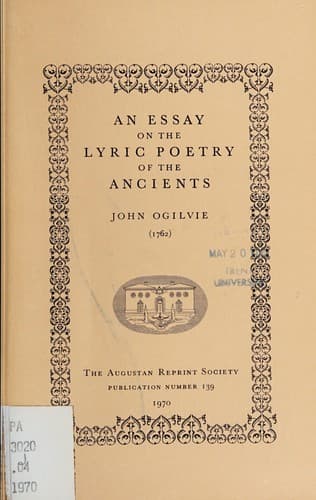
An Essay on the Lyric Poetry of the AncientsOgilvie, John
History
An Essay on the Lyric Poetry of the Ancients
Ogilvie, John
Classical poetry -- History and criticism
From the preceding short account of this celebrated Ode, it will appear
that the transitions are extremely artful, the sentiments noble, and
that the whole conduct is happy and judicious. These, if I mistake not,
are the distinguishing excellencies of the larger Odes of Horace, in
which the Poet’s _didactic_ genius is remarkably conspicuous. Perhaps
however, your Lordship, like the French Critic, is at a loss to find in
all this, the energy, the vehemence, the exuberance of Pindar. Horace
himself was perfectly sensible of the superior excellence of the Greek
Poet, and never rises to truer sublimity than when he is drawing his
character. The following image is great, and appropriated to the
subject.
_Monte decurrens velut amnis, imbres
Quem super notas aluere ripas
Fervet, immensusque _ruit_ profundo
Pindarus ore[96]._
Pindar like some fierce torrent swoln with show’rs,
Or sudden Cataracts of melting Snow,
Which from the Alps its headlong Deluge pours,
And foams, and thunders o’er the Vales below,
With desultory fury borne along,
Rolls his impetuous, vast, unfathomable song. WEST.
[Footnote 96: Car. Lib. IV. Od. 2.]
I know not, my Lord, how it happens, that we generally find ourselves
more highly pleased with excess and inequality in poetic composition,
than with the serene, the placid, and the regular progression of a
corrected imagination. Is it because the mind is satiated with
uniformity of any kind, and that remarkable blemishes, like a few barren
fields interspersed in a landschape give additional lustre to the more
cultivated scenery? Or does it proceed from a propensity in human nature
to be pleased, when we observe a great Genius sometimes _sinking as far
below the common level_, as at others, he is capable of _rising above
it_? I confess, that I am inclined to deduce this feeling more
frequently from the _former_ than from the _latter_ of these causes;
though I am afraid that the warmest _benevolence_ will hardly prevail
upon your Lordship not to attribute it in some instances to _a mixture
of both_.
Whatever may be in this, it is certain that the Odes of Horace, in which
he has professedly imitated Pindar, are much more correct and faultless
than these of his Master. It would, perhaps, be saying too much, to
affirm with some Critics, that the judgment of the Roman Poet was
superior to that of his Rival; but it is obvious, that the operation of
this Faculty is more remarkable in his writings, because his imagination
was more ductile and pliable. --Upon the whole, therefore, we shall not
do injustice to these two great men, if we assign to their works the
same degree of comparative excellence, which the Italians ascribe to the
pieces of Dominichino and Guido. The former was a _great_ but an
_unequal Genius_; while the more corrected performances of the latter
were _animated by the Graces_, and _touched by the pencil of
Elegance_[97].
Public-domain text, read in full here on John Shaqi.
Reviews
Reviews
No reviews yet
Be the first to share your thoughts on this work.
Elsewhere in the archive
Join the Discussion
Join the discussion
Sign in to leave a comment or review.
Sign InorCreate an account