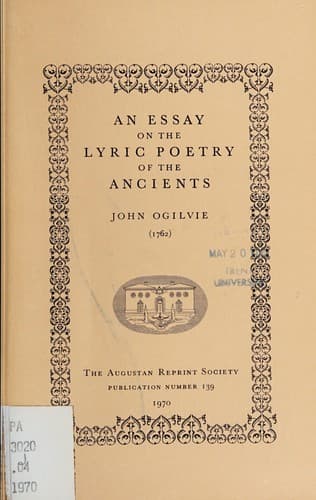
An Essay on the Lyric Poetry of the AncientsOgilvie, John
History
An Essay on the Lyric Poetry of the Ancients
Ogilvie, John
Classical poetry -- History and criticism
[Footnote 97: The Reader will observe, that nothing has been said
in this Essay on the regularity of the measure of Pindar’s Odes.
This subject is treated so fully in the preface of Mr. West’s
Translation, that we need only here to refer the curious to his
remarks. The Ancient Odes are always to be considered as songs
which were set to musick, and whose recital was generally
accompanied with dancing. If we may be permitted to form an idea
of this music, from the nature and composition of the Ode, it must
have been a matter of great difficulty to excel in it, as it is
certain that poems which abound with sentiments are more proper to
be set to music, than those which are ornamented with imagery.
These sister-arts usually keep pace with each other, either in
their improvement or decay. Ne ci dobbiamo (says an ingenious
Foreigner, speaking of the modern Italian music) maravigliare,
ce corrotta la Poesia, s’e anche corrotta la musica; perche come
nella ragior poetica accennammo, tutte le arti imitative hanno
una idea commune, dalla cui alterazione si alterano tutte,
e particolarmenti la musica dall alterazion del la poesia si cangia
come dal corpo l’ombra. Onde corrotta la poesia da e soverchi
ornamenti e dalla copia delle figure, ha communicato anche il suo
morbo alla musica, ormai tanto sfigurata, che ha perduta quasi la
natural est pressione. Gavina della Traged. p. 70.]
I am afraid, that your Lordship is now thinking it high time to
bring the whole of this detail to a period.----Upon reviewing the
observations made on the Lyric Poetry of the Ancients through the
preceding part of this Essay, you will find that the subject has been
considered under the three following heads. In the first part I have
attempted to lay before your Lordship, the state of Lyric Poetry in the
earliest ages, as it appears from what we can collect either of the
character of the writings of Amphion, Linus, Orpheus, Museus, and
Hesiod. In the course of this enquiry I have had occasion to assign the
causes, whose concurrence rendered this branch of the poetic Art less
perfect at its first introduction than any of the other species. --Upon
advancing a little further, a richer and more diversified prospect
opened to the imagination. In _the first dawn_ of this more enlightened
period, we meet with the names of Alcaeus and Sappho, who, without
altering _the original character_ of the Ode, made a considerable change
on the _subjects_ to which it was appropriated; and in _the full
meridian_ of Science, we find this second form of Lyric Poetry brought
to its highest perfection in the writings of Horace. --Some remarks on
the nature of those beauties which are peculiarly characteristic of the
_higher species_ of the Ode, and on the part which Imagination
particularly claims in its composition, led me to mention, a few rules,
Public-domain text, read in full here on John Shaqi.
Reviews
Reviews
No reviews yet
Be the first to share your thoughts on this work.
Elsewhere in the archive
Join the Discussion
Join the discussion
Sign in to leave a comment or review.
Sign InorCreate an account