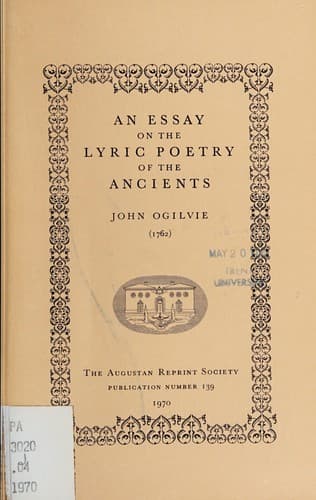
An Essay on the Lyric Poetry of the AncientsOgilvie, John
History
An Essay on the Lyric Poetry of the Ancients
Ogilvie, John
Classical poetry -- History and criticism
The facsimile of the title page includes two handwritten lines between
“Lord Deskfoord” and the author’s name:
The last Earl of Findlater who died _1812_ without issue
Title claimed by Sir W^m Ogilvie Bart of Carnousie,
who died Feb 20^th _1861_
The two lines were probably written at different times: the first uses
long “s” while the second had to have been written in or after 1861. The
underlined year “1812” is an error for 1811 (October). The William
Ogilvie (more often spelled Ogilvy) of the second line was born in 1810,
so his claim to the title cannot have been immediate. He does not appear
to have been related to the book’s author.
2. Italian
The quotation from Gravina (misspelled Gavina), _Della Tragedia_, is
given exactly as printed in note 97, including clear errors. The passage
appears in the 1819 _Opere Scelte_ (Selected Works) as:
Né ci dobbiamo maravigliare, se corrotta la poesia, si è anche corrotta
la musica: perché, come nella Ragion Poetica accennammo, tutte le arti
imitative hanno una idea comune, dalla cui alterazione si alterano
tutte; e particolarmente la musica dall’ alterazion della poesia si
cangia, come dal corpo l’ombra. Onde corrotta la poesia dai soverchi
ornamenti e dalla copia delle figure, ha comunicato il suo morbo anche
alla musica, ormai tanto figurata, che ha perduta quasi la natural
espressione.
3. Greek
The printed Greek used no diacritics, except for the one word ὅς
(including accent) in the Odyssey quotation. All other rough-breathing
marks have been added by the transcriber. Line breaks in verse citations
are as in the original.
The errors are unusual. Instead of confusing similar letters such as υ
and ν, or garbling diacritics, the Greek passages read as if they were
learned orally, and written down from memory. Substitutions of ο for ω
and ι for ε are especially common. The more significant differences
between Ogilvie’s text and “standard” readings are given here.
Aristotle, _Poetics_ 1448b (in footnotes 3, 5, 6 as “c. 4”):
Και Ἁρμονια και ρυθμος εξ αρχης
_or:_ τῆς ἁρμονίας καὶ τοῦ ῥυθμοῦ ... ἐξ ἀρχῆς
οἱτινες θηρεων τε μορφας των αγριοτατων και νεκρων
_or:_ οἷον θηρίων τε μορφὰς τῶν ἀτιμοτάτων καὶ νεκρῶν
Τα γαρ μετρα ὁτι μοιρον των ρυθμων ...
_or:_ τὰ γὰρ μέτρα ὅτι μόρια τῶν ῥυθμῶν ...
Plato, _Leges_ 669de (in footnote 7 as “Lib. XI”):
Μελος δε αυ και ρυθμους ανευ ρημα{των} [_end of word illegible_]
_or:_ μέλος δ’ αὖ καὶ ῥυθμὸν ἄνευ ῥημάτων
Hesiod, _Theogony_ 31 (in footnote 31 as l. 63):
Δρεψασθαι θηητον· επενευσαν δε μοι αυδην
_or:_ δρέψασαι, θηητόν· ἐνέπνευσαν δέ μοι αὐδὴν
Aristotle, _Poetics_ 1449a (in footnote 52 as “c. 4”):
... οἱ δε αντι των Επων τραγωδιδασκαλοι, δια τω μειζω
και ενεμοτερα τα σχηματα ειναι ...
_or:_ ... οἱ δὲ ἀντὶ τῶν ἐπῶν τραγῳδοδιδάσκαλοι, διὰ τὸ μείζω
καὶ ἐντιμότερα τὰ σχήματα εἶναι ...
Callimachus I. 68-69 (body text and footnote 63):
Public-domain text, read in full here on John Shaqi.
Reviews
Reviews
No reviews yet
Be the first to share your thoughts on this work.
Elsewhere in the archive
Join the Discussion
Join the discussion
Sign in to leave a comment or review.
Sign InorCreate an account