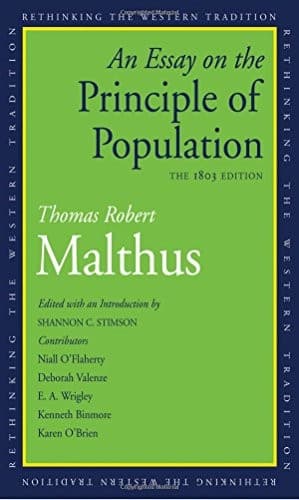
An Essay on the Principle of PopulationMalthus, T. R. (Thomas Robert)
Philosophy
An Essay on the Principle of Population
Malthus, T. R. (Thomas Robert)
Population
A person who contemplated the happy state of the lower classes of
people in America twenty years ago would naturally wish to retain them
for ever in that state, and might think, perhaps, that by preventing
the introduction of manufactures and luxury he might effect his
purpose, but he might as reasonably expect to prevent a wife or
mistress from growing old by never exposing her to the sun or air. The
situation of new colonies, well governed, is a bloom of youth that no
efforts can arrest. There are, indeed, many modes of treatment in the
political, as well as animal, body, that contribute to accelerate or
retard the approaches of age, but there can be no chance of success, in
any mode that could be devised, for keeping either of them in perpetual
youth. By encouraging the industry of the towns more than the industry
of the country, Europe may be said, perhaps, to have brought on a
premature old age. A different policy in this respect would infuse
fresh life and vigour into every state. While from the law of
primogeniture, and other European customs, land bears a monopoly price,
a capital can never be employed in it with much advantage to the
individual; and, therefore, it is not probable that the soil should be
properly cultivated. And, though in every civilized state a class of
proprietors and a class of labourers must exist, yet one permanent
advantage would always result from a nearer equalization of property.
The greater the number of proprietors, the smaller must be the number
of labourers: a greater part of society would be in the happy state of
possessing property: and a smaller part in the unhappy state of
possessing no other property than their labour. But the best directed
exertions, though they may alleviate, can never remove the pressure of
want, and it will be difficult for any person who contemplates the
genuine situation of man on earth, and the general laws of nature, to
suppose it possible that any, the most enlightened, efforts could place
mankind in a state where 'few would die without measuring out the whole
period of present existence allotted to them; where pain and distemper
would be unknown among them; and death would come upon them like a
sleep, in consequence of no other cause than gradual and unavoidable
decay.'
Public-domain text, read in full here on John Shaqi.
Reviews
Reviews
No reviews yet
Be the first to share your thoughts on this work.
Elsewhere in the archive
Join the Discussion
Join the discussion
Sign in to leave a comment or review.
Sign InorCreate an account