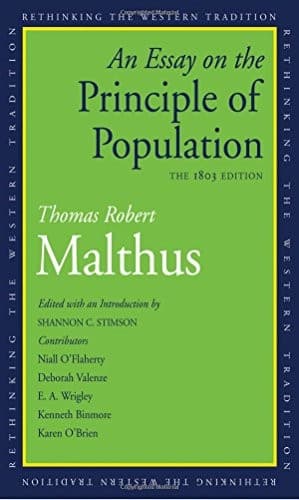
An Essay on the Principle of PopulationMalthus, T. R. (Thomas Robert)
Philosophy
An Essay on the Principle of Population
Malthus, T. R. (Thomas Robert)
Population
It cannot be considered as an unimproving exercise of the human mind to
endeavour to 'vindicate the ways of God to man' if we proceed with a
proper distrust of our own understandings and a just sense of our
insufficiency to comprehend the reason of all we see, if we hail every
ray of light with gratitude, and, when no light appears, think that the
darkness is from within and not from without, and bow with humble
deference to the supreme wisdom of him whose 'thoughts are above our
thoughts' 'as the heavens are high above the earth.'
In all our feeble attempts, however, to 'find out the Almighty to
perfection', it seems absolutely necessary that we should reason from
nature up to nature's God and not presume to reason from God to nature.
The moment we allow ourselves to ask why some things are not otherwise,
instead of endeavouring to account for them as they are, we shall never
know where to stop, we shall be led into the grossest and most childish
absurdities, all progress in the knowledge of the ways of Providence
must necessarily be at an end, and the study will even cease to be an
improving exercise of the human mind. Infinite power is so vast and
incomprehensible an idea that the mind of man must necessarily be
bewildered in the contemplation of it. With the crude and puerile
conceptions which we sometimes form of this attribute of the Deity, we
might imagine that God could call into being myriads and myriads of
existences, all free from pain and imperfection, all eminent in
goodness and wisdom, all capable of the highest enjoyments, and
unnumbered as the points throughout infinite space. But when from these
vain and extravagant dreams of fancy, we turn our eyes to the book of
nature, where alone we can read God as he is, we see a constant
succession of sentient beings, rising apparently from so many specks of
matter, going through a long and sometimes painful process in this
world, but many of them attaining, ere the termination of it, such high
qualities and powers as seem to indicate their fitness for some
superior state. Ought we not then to correct our crude and puerile
ideas of infinite Power from the contemplation of what we actually see
existing? Can we judge of the Creator but from his creation? And,
unless we wish to exalt the power of God at the expense of his
goodness, ought we not to conclude that even to the great Creator,
almighty as he is, a certain process may be necessary, a certain time
(or at least what appears to us as time) may be requisite, in order to
form beings with those exalted qualities of mind which will fit them
for his high purposes?
Public-domain text, read in full here on John Shaqi.
Reviews
Reviews
No reviews yet
Be the first to share your thoughts on this work.
Elsewhere in the archive
Join the Discussion
Join the discussion
Sign in to leave a comment or review.
Sign InorCreate an account