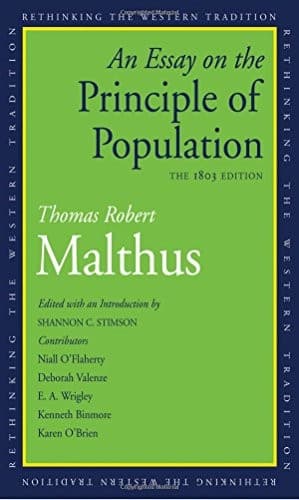
An Essay on the Principle of PopulationMalthus, T. R. (Thomas Robert)
Philosophy
An Essay on the Principle of Population
Malthus, T. R. (Thomas Robert)
Population
The first great awakeners of the mind seem to be the wants of the body.
(It was my intention to have entered at some length into this subject
as a kind of second part to the Essay. A long interruption, from
particular business, has obliged me to lay aside this intention, at
least for the present. I shall now, therefore, only give a sketch of a
few of the leading circumstances that appear to me to favour the
general supposition that I have advanced.) They are the first
stimulants that rouse the brain of infant man into sentient activity,
and such seems to be the sluggishness of original matter that unless by
a peculiar course of excitements other wants, equally powerful, are
generated, these stimulants seem, even afterwards, to be necessary to
continue that activity which they first awakened. The savage would
slumber for ever under his tree unless he were roused from his torpor
by the cravings of hunger or the pinchings of cold, and the exertions
that he makes to avoid these evils, by procuring food, and building
himself a covering, are the exercises which form and keep in motion his
faculties, which otherwise would sink into listless inactivity. From
all that experience has taught us concerning the structure of the human
mind, if those stimulants to exertion which arise from the wants of the
body were removed from the mass of mankind, we have much more reason to
think that they would be sunk to the level of brutes, from a deficiency
of excitements, than that they would be raised to the rank of
philosophers by the possession of leisure. In those countries where
nature is the most redundant in spontaneous produce the inhabitants
will not be found the most remarkable for acuteness of intellect.
Necessity has been with great truth called the mother of invention.
Some of the noblest exertions of the human mind have been set in motion
by the necessity of satisfying the wants of the body. Want has not
unfrequently given wings to the imagination of the poet, pointed the
flowing periods of the historian, and added acuteness to the researches
of the philosopher, and though there are undoubtedly many minds at
present so far improved by the various excitements of knowledge, or of
social sympathy, that they would not relapse into listlessness if their
bodily stimulants were removed, yet it can scarcely be doubted that
these stimulants could not be withdrawn from the mass of mankind
without producing a general and fatal torpor, destructive of all the
germs of future improvement.
Public-domain text, read in full here on John Shaqi.
Reviews
Reviews
No reviews yet
Be the first to share your thoughts on this work.
Elsewhere in the archive