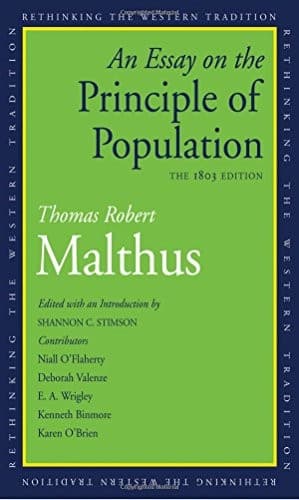
An Essay on the Principle of PopulationMalthus, T. R. (Thomas Robert)
Philosophy
An Essay on the Principle of Population
Malthus, T. R. (Thomas Robert)
Population
As the reasons, therefore, for the constancy of the laws of nature
seem, even to our understandings, obvious and striking; if we return to
the principle of population and consider man as he really is, inert,
sluggish, and averse from labour, unless compelled by necessity (and it
is surely the height of folly to talk of man, according to our crude
fancies of what he might be), we may pronounce with certainty that the
world would not have been peopled, but for the superiority of the power
of population to the means of subsistence. Strong and constantly
operative as this stimulus is on man to urge him to the cultivation of
the earth, if we still see that cultivation proceeds very slowly, we
may fairly conclude that a less stimulus would have been insufficient.
Even under the operation of this constant excitement, savages will
inhabit countries of the greatest natural fertility for a long period
before they betake themselves to pasturage or agriculture. Had
population and food increased in the same ratio, it is probable that
man might never have emerged from the savage state. But supposing the
earth once well peopled, an Alexander, a Julius Caesar, a Tamberlane,
or a bloody revolution might irrecoverably thin the human race, and
defeat the great designs of the Creator. The ravages of a contagious
disorder would be felt for ages; and an earthquake might unpeople a
region for ever. The principle, according to which population
increases, prevents the vices of mankind, or the accidents of nature,
the partial evils arising from general laws, from obstructing the high
purpose of the creation. It keeps the inhabitants of the earth always
fully up to the level of the means of subsistence; and is constantly
acting upon man as a powerful stimulus, urging him to the further
cultivation of the earth, and to enable it, consequently, to support a
more extended population. But it is impossible that this law can
operate, and produce the effects apparently intended by the Supreme
Being, without occasioning partial evil. Unless the principle of
population were to be altered according to the circumstances of each
separate country (which would not only be contrary to our universal
experience, with regard to the laws of nature, but would contradict
even our own reason, which sees the absolute necessity of general laws
for the formation of intellect), it is evident that the same principle
which, seconded by industry, will people a fertile region in a few
years must produce distress in countries that have been long inhabited.
Public-domain text, read in full here on John Shaqi.
Reviews
Reviews
No reviews yet
Be the first to share your thoughts on this work.
Elsewhere in the archive
Join the Discussion
Join the discussion
Sign in to leave a comment or review.
Sign InorCreate an account