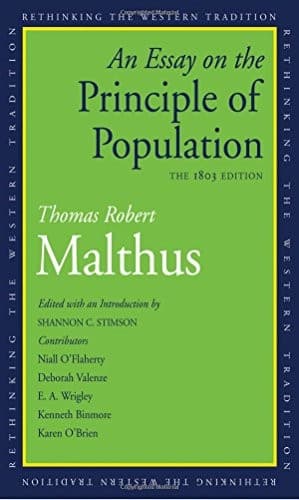
An Essay on the Principle of PopulationMalthus, T. R. (Thomas Robert)
Philosophy
An Essay on the Principle of Population
Malthus, T. R. (Thomas Robert)
Population
When these two fundamental laws of society, the security of property,
and the institution of marriage, were once established, inequality of
conditions must necessarily follow. Those who were born after the
division of property would come into a world already possessed. If
their parents, from having too large a family, could not give them
sufficient for their support, what are they to do in a world where
everything is appropriated? We have seen the fatal effects that would
result to a society, if every man had a valid claim to an equal share
of the produce of the earth. The members of a family which was grown
too large for the original division of land appropriated to it could
not then demand a part of the surplus produce of others, as a debt of
justice. It has appeared, that from the inevitable laws of our nature
some human beings must suffer from want. These are the unhappy persons
who, in the great lottery of life, have drawn a blank. The number of
these claimants would soon exceed the ability of the surplus produce to
supply. Moral merit is a very difficult distinguishing criterion,
except in extreme cases. The owners of surplus produce would in general
seek some more obvious mark of distinction. And it seems both natural
and just that, except upon particular occasions, their choice should
fall upon those who were able, and professed themselves willing, to
exert their strength in procuring a further surplus produce; and thus
at once benefiting the community, and enabling these proprietors to
afford assistance to greater numbers. All who were in want of food
would be urged by imperious necessity to offer their labour in exchange
for this article so absolutely essential to existence. The fund
appropriated to the maintenance of labour would be the aggregate
quantity of food possessed by the owners of land beyond their own
consumption. When the demands upon this fund were great and numerous,
it would naturally be divided in very small shares. Labour would be ill
paid. Men would offer to work for a bare subsistence, and the rearing
of families would be checked by sickness and misery. On the contrary,
when this fund was increasing fast, when it was great in proportion to
the number of claimants, it would be divided in much larger shares. No
man would exchange his labour without receiving an ample quantity of
food in return. Labourers would live in ease and comfort, and would
consequently be able to rear a numerous and vigorous offspring.
On the state of this fund, the happiness, or the degree of misery,
prevailing among the lower classes of people in every known state at
present chiefly depends. And on this happiness, or degree of misery,
depends the increase, stationariness, or decrease of population.
Public-domain text, read in full here on John Shaqi.
Reviews
Reviews
No reviews yet
Be the first to share your thoughts on this work.
Elsewhere in the archive
Join the Discussion
Join the discussion
Sign in to leave a comment or review.
Sign InorCreate an account