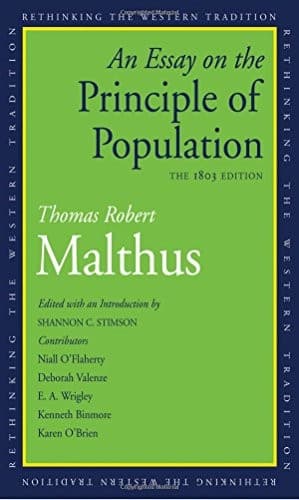
An Essay on the Principle of PopulationMalthus, T. R. (Thomas Robert)
Philosophy
An Essay on the Principle of Population
Malthus, T. R. (Thomas Robert)
Population
What a strange and curious proof do these conjectures exhibit of the
inconsistency of scepticism! For it should be observed, that there is a
very striking and essential difference between believing an assertion
which absolutely contradicts the most uniform experience, and an
assertion which contradicts nothing, but is merely beyond the power of
our present observation and knowledge. So diversified are the natural
objects around us, so many instances of mighty power daily offer
themselves to our view, that we may fairly presume, that there are many
forms and operations of nature which we have not yet observed, or
which, perhaps, we are not capable of observing with our present
confined inlets of knowledge. The resurrection of a spiritual body from
a natural body does not appear in itself a more wonderful instance of
power than the germination of a blade of wheat from the grain, or of an
oak from an acorn. Could we conceive an intelligent being, so placed as
to be conversant only with inanimate or full grown objects, and never
to have witnessed the process of vegetation and growth; and were
another being to shew him two little pieces of matter, a grain of
wheat, and an acorn, to desire him to examine them, to analyse them if
he pleased, and endeavour to find out their properties and essences;
and then to tell him, that however trifling these little bits of matter
might appear to him, that they possessed such curious powers of
selection, combination, arrangement, and almost of creation, that upon
being put into the ground, they would choose, amongst all the dirt and
moisture that surrounded them, those parts which best suited their
purpose, that they would collect and arrange these parts with wonderful
taste, judgement, and execution, and would rise up into beautiful
forms, scarcely in any respect analogous to the little bits of matter
which were first placed in the earth. I feel very little doubt that the
imaginary being which I have supposed would hesitate more, would
require better authority, and stronger proofs, before he believed these
strange assertions, than if he had been told, that a being of mighty
power, who had been the cause of all that he saw around him, and of
that existence of which he himself was conscious, would, by a great act
of power upon the death and corruption of human creatures, raise up the
essence of thought in an incorporeal, or at least invisible form, to
give it a happier existence in another state.
Public-domain text, read in full here on John Shaqi.
Reviews
Reviews
No reviews yet
Be the first to share your thoughts on this work.
Elsewhere in the archive
Join the Discussion
Join the discussion
Sign in to leave a comment or review.
Sign InorCreate an account