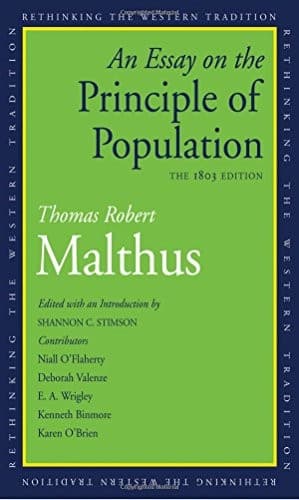
An Essay on the Principle of PopulationMalthus, T. R. (Thomas Robert)
Philosophy
An Essay on the Principle of Population
Malthus, T. R. (Thomas Robert)
Population
I ought perhaps again to make an apology to my readers for dwelling so
long upon a conjecture which many, I know, will think too absurd and
improbable to require the least discussion. But if it be as improbable
and as contrary to the genuine spirit of philosophy as I own I think it
is, why should it not be shewn to be so in a candid examination? A
conjecture, however improbable on the first view of it, advanced by
able and ingenious men, seems at least to deserve investigation. For my
own part I feel no disinclination whatever to give that degree of
credit to the opinion of the probable immortality of man on earth,
which the appearances that can be brought in support of it deserve.
Before we decide upon the utter improbability of such an event, it is
but fair impartially to examine these appearances; and from such an
examination I think we may conclude, that we have rather less reason
for supposing that the life of man may be indefinitely prolonged, than
that trees may be made to grow indefinitely high, or potatoes
indefinitely large. Though Mr Godwin advances the idea of the
indefinite prolongation of human life merely as a conjecture, yet as he
has produced some appearances, which in his conception favour the
supposition, he must certainly intend that these appearances should be
examined and this is all that I have meant to do.
CHAPTER 13
Error of Mr Godwin is considering man too much in the light of a being
merely rational--In the compound being, man, the passions will always
act as disturbing forces in the decisions of the
understanding--Reasonings of Mr Godwin on the subject of coercion--Some
truths of a nature not to be communicated from one man to another.
In the chapter which I have been examining, Mr Godwin professes to
consider the objection to his system of equality from the principle of
population. It has appeared, I think clearly, that he is greatly
erroneous in his statement of the distance of this difficulty, and that
instead of myriads of centuries, it is really not thirty years, or even
thirty days, distant from us. The supposition of the approach of man to
immortality on earth is certainly not of a kind to soften the
difficulty. The only argument, therefore, in the chapter which has any
tendency to remove the objection is the conjecture concerning the
extinction of the passion between the sexes, but as this is a mere
conjecture, unsupported by the smallest shadow of proof, the force of
the objection may be fairly said to remain unimpaired, and it is
undoubtedly of sufficient weight of itself completely to overturn Mr
Godwin's whole system of equality. I will, however, make one or two
observations on a few of the prominent parts of Mr Godwin's reasonings
which will contribute to place in a still clearer point of view the
little hope that we can reasonably entertain of those vast improvements
in the nature of man and of society which he holds up to our admiring
gaze in his Political Justice.
Public-domain text, read in full here on John Shaqi.
Reviews
Reviews
No reviews yet
Be the first to share your thoughts on this work.
Elsewhere in the archive
Join the Discussion
Join the discussion
Sign in to leave a comment or review.
Sign InorCreate an account