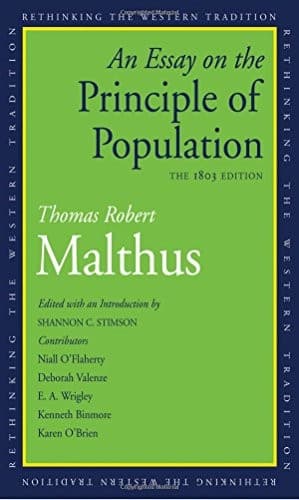
An Essay on the Principle of PopulationMalthus, T. R. (Thomas Robert)
Philosophy
An Essay on the Principle of Population
Malthus, T. R. (Thomas Robert)
Population
Man, according to Mr Godwin, is a creature formed what he is by the
successive impressions which he has received, from the first moment
that the germ from which he sprung was animated. Could he be placed in
a situation, where he was subject to no evil impressions whatever,
though it might be doubted whether in such a situation virtue could
exist, vice would certainly be banished. The great bent of Mr Godwin's
work on Political Justice, if I understand it rightly, is to shew that
the greater part of the vices and weaknesses of men proceed from the
injustice of their political and social institutions, and that if these
were removed and the understandings of men more enlightened, there
would be little or no temptation in the world to evil. As it has been
clearly proved, however, (at least as I think) that this is entirely a
false conception, and that, independent of any political or social
institutions whatever, the greater part of mankind, from the fixed and
unalterable laws of nature, must ever be subject to the evil
temptations arising from want, besides other passions, it follows from
Mr Godwin's definition of man that such impressions, and combinations
of impressions, cannot be afloat in the world without generating a
variety of bad men. According to Mr Godwin's own conception of the
formation of character, it is surely as improbable that under such
circumstances all men will be virtuous as that sixes will come up a
hundred times following upon the dice. The great variety of
combinations upon the dice in a repeated succession of throws appears
to me not inaptly to represent the great variety of character that must
necessarily exist in the world, supposing every individual to be formed
what he is by that combination of impressions which he has received
since his first existence. And this comparison will, in some measure,
shew the absurdity of supposing, that exceptions will ever become
general rules; that extraordinary and unusual combinations will be
frequent; or that the individual instances of great virtue which had
appeared in all ages of the world will ever prevail universally.
Public-domain text, read in full here on John Shaqi.
Reviews
Reviews
No reviews yet
Be the first to share your thoughts on this work.
Elsewhere in the archive
Join the Discussion
Join the discussion
Sign in to leave a comment or review.
Sign InorCreate an account