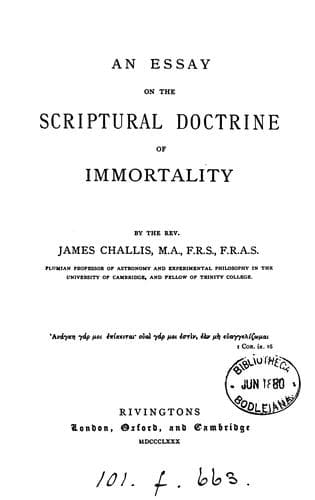
An Essay on the Scriptural Doctrine of ImmortalityChallis, James
Religion
An Essay on the Scriptural Doctrine of Immortality
Challis, James
Immortality
But it is possible that the faithful, after receiving the grace of
Christ and fellowship of the Spirit, may by unrighteous conduct "grieve
the Holy Spirit" (Eph. iv. 80), and even by persistence in sin defile
the gift of the Spirit which had been imparted to them. In the
foregoing passage from St. Matthew xii., it is said that there is
forgiveness for one who "speaketh against the Son of man," which
expression may signify, generally, wilful and overt opposition to "the
law of Christ" (Gal. vi. 2); but that there is no forgiveness for one
who _speaks_ against the Holy Spirit, i.e. one who by wilful and
_overt_ conduct does violence to the sanctifying influence of the Holy
Spirit which he has already partaken of. Of such an one it is written
in Heb. x. 29, "he hath trodden underfoot the Son of God, and hath
counted the blood of the covenant wherewith he was sanctified an unholy
thing, and hath done despite to the Spirit of grace." But not every
sin committed after faith and the baptism of repentance has this
effect. The apostle John tells us that although all unrighteousness
{87} (_adikia_, transgression of the strict law of Christ) is sin,
there is sin of a believing brother which is not unto death, and may be
repented of in this world; and there is sin unto death, respecting
which prayer for repentance would be unavailing (1 Epist. v. 16, 17).
This is "the blasphemy of the Spirit," which is not forgiven in this
world, because forgiveness implies repentance; neither is it forgiven
in the world to come, because beyond the grave there is no repentance.
What remains for such sinners is the "[oe]onian judgment" (see p. 69)
mentioned in St. Mark iii. 29, and "the sorer punishment" spoken of in
Heb. x. 29, which is the same as the condemnation to the second death
consequent upon that judgment. (I take occasion to remark that in Mark
iii. 29, instead of _kriseos_, some early manuscripts have
_amaritematos_, which, as far as I can see, does not admit of being
interpreted consistently with the context and the usage of _enochos_.)
Public-domain text, read in full here on John Shaqi.
Reviews
Reviews
No reviews yet
Be the first to share your thoughts on this work.
Join the Discussion
Join the discussion
Sign in to leave a comment or review.
Sign InorCreate an account