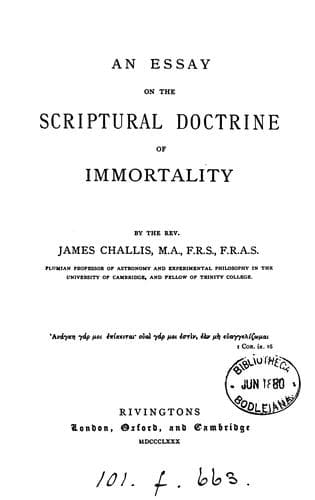
An Essay on the Scriptural Doctrine of ImmortalityChallis, James
Religion
An Essay on the Scriptural Doctrine of Immortality
Challis, James
Immortality
It is, no doubt, beyond the limit of our thoughts, conditioned as we
are by time, to conceive of a state of things in which time is no more.
Apparently for this reason commentators have proposed to translate,
_chronos ouk estai eti_, "the time shall not be yet," or "time shall no
more intervene." The former of these translations is excluded by the
usage of _ouk eti_ in the analogous affirmations in Rev. xxi. 1, 4, and
the other, which is an arbitrary comment rather than a translation, is
for the same reason excluded. (I have preferred _ouk estai eti_ to
_ouketi estai_, because the words occur in the former order in each of
the three instances in Rev. xxi.) There can be no question as to the
philological correctness of the translation, "time shall be no more."
The unwillingness to admit it appears to have arisen solely from a
fixed persuasion, gratuitously and very generally entertained, that
time {96} has a _necessary_ existence, and therefore cannot come to an
end. Some have affirmed that when time ends, eternity begins; which is
a self-contradictory dogma, because eternity (from _[oe]tas_) is
essentially time. The teaching of Scripture on this point is directly
opposed to these views; for the apostle Peter tells those for whose
sake he wrote his second Epistle, to bear in mind "this one thing, that
one day is with the Lord as a thousand years, and a thousand years as
one day" (2 Epist. iii. 8). This is equivalent to saying that time is
not an independent entity, but that both its existence and its quality
are determined by the _will_ of the Creator of all things. It is in
virtue of our being made in His image, and partaking intellectually of
the divine nature, that we are capable _in thought_ of giving
indefinite and arbitrary extension to time, whether it be past time or
time to come. This faculty, as I have already argued in p. 80, is to
be placed in the category of the different conditions, whether
depending on experience of the course of time, or on affections of our
bodily and mental constitutions, under which the spirit of man is
formed for immortality. All such conditions are determined by the
purpose for which they are imposed, and when that purpose is fulfilled
in the perfection of humanity the conditions come to an end. It is
thus that the being conditioned by time eventually ceases.
Public-domain text, read in full here on John Shaqi.
Reviews
Reviews
No reviews yet
Be the first to share your thoughts on this work.
Join the Discussion
Join the discussion
Sign in to leave a comment or review.
Sign InorCreate an account