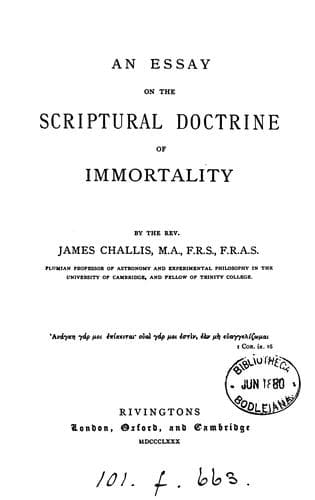
An Essay on the Scriptural Doctrine of ImmortalityChallis, James
Religion
An Essay on the Scriptural Doctrine of Immortality
Challis, James
Immortality
It will be proper here to meet an objection to the {97} doctrine that
time will have an end which might be drawn from the expression, _eis
tous aionas ton aionon_, which frequently occurs in Scripture, and
seems to be indicative of an unlimited succession of ages. So far as
time is under human cognizance, and has relation to human experience,
Scripture speaks in express terms of only _two_ ages--the present one,
which lasts to the end of the _generations_ of men in the existing
order of things; and the age to come, which embraces the course of the
judgment of all who lived in the first age, and terminates with the
second death of those who had no part in the first resurrection. When
it is said of the Creator of heaven and earth, that He is "from
everlasting to everlasting" (_apo tou aionos meos tou aionos su ei_,
Ps. xc. 2), and that "He liveth for ever and ever" (_ho zon eis tous
aionas ton aionon_, Rev. x. 6), the word _aion_ is not used to signify,
as in the instances of the two "ages" just mentioned, an interval
having beginning and ending, but is to be taken in an abstract sense,
derived from our ordinary perception of the existence and quality of
time, and from the faculty which, as said before, we possess of
thinking of time as indefinitely extended. The first of the cited
passages affirms what in these days we should express by saying that
God is necessarily and essentially self-existent, and the other, what
we mean by saying that He is necessarily and essentially a _living_
God. But {98} Scripture uses no such terms as these, because it is
written on the principle of employing in an abstract sense only such
terms as are rendered intelligible by personal sensation and
observation, and by experience drawn under actual conditions from the
outer world. It is thus that the word "age" acquired its primary
meaning, before it was susceptible of the abstract application just
mentioned.
Public-domain text, read in full here on John Shaqi.
Reviews
Reviews
No reviews yet
Be the first to share your thoughts on this work.
Join the Discussion
Join the discussion
Sign in to leave a comment or review.
Sign InorCreate an account