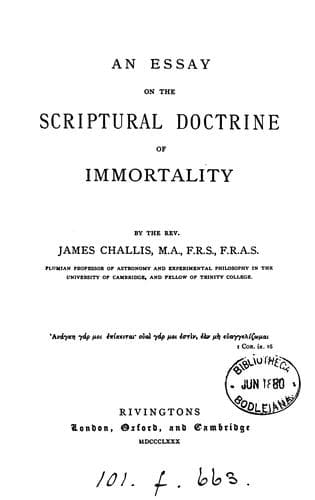
An Essay on the Scriptural Doctrine of ImmortalityChallis, James
Religion
An Essay on the Scriptural Doctrine of Immortality
Challis, James
Immortality
It has already been noticed that St. Peter {100} characterizes "the new
heavens and the new earth" by saying that "righteousness dwells
therein." This is as much as to say that it is a perfect _social_
state, whose end is at once the glory of God and the happiness of man.
The words of the apostle (2 Epist. iii. 13) signify that the new
creation, by satisfying this condition, is the fulfilment of an
antecedent promise. Now, the argument of this Essay is in entire
agreement with this doctrine, inasmuch as it was from the first assumed
(p. 9) that immortality cannot consist with any other than a state of
righteousness, and then (pp. 19 and 20) it was argued that after Adam's
transgression a _promise_ was made that himself and his race would
eventually be exempt from the power of Satan and attain to immortality.
The passage Rev. xxi. 1-4, quoted in p. 92, seems to certify the
complete fulfilment of this promise and to indicate the manner of its
fulfilment. But there are other passages in this concluding portion of
the Apocalypse, which might be thought to bear a contrary
signification, to which, therefore, our attention must now be directed.
In xxi. 8 we have, "But the fearful, and unbelieving, and the
abominable, and murderers, and fornicators, and sorcerers, and
idolaters, and all lies, shall have their part in the lake which
burneth with fire and brimstone: which is the second death." If we
give to this symbolism, as consistency requires, {101} an
interpretation analogous to that applied to Rev. xx. 10, we shall
conclude that sinners of all classes will eventually have no cognizable
existence, transgression being brought to an end by the effect of the
general judgment and the pains of the second death. This may explain
why it is added, "which is the second death." It is worthy of remark
that "all lies" are said to have their part in "the lake" although the
casting of lies into a lake is objectively an impossibility. But this
variation of the designation ("lies" being put for "liars") may be
intended to signify generally that all transgression disappears,
because transgressors cease to be cognizable _as transgressors_.
There is another thing to be noticed respecting the same passage: it
contains no such clause as, "They shall be tormented day and night to
the ages of ages," which occurs at the end of Rev. xx. 10. This
omission may be accounted for on the principle stated in p. 96,
according to which expressions involving time are not applicable to the
condition of things in the new creation, in which time exists no more.
Public-domain text, read in full here on John Shaqi.
Reviews
Reviews
No reviews yet
Be the first to share your thoughts on this work.
Join the Discussion
Join the discussion
Sign in to leave a comment or review.
Sign InorCreate an account