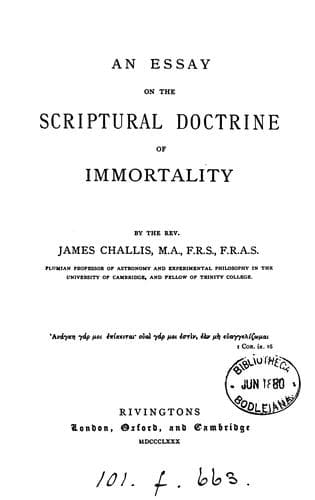
An Essay on the Scriptural Doctrine of ImmortalityChallis, James
Religion
An Essay on the Scriptural Doctrine of Immortality
Challis, James
Immortality
I take the occasion to remark here that the above-cited clause appears
to be the only passage in the Apocalypse which asserts the perpetuity
of _personal_ experience of torment, as distinct from the perpetuity of
its effect; also that the personal subject of the verb
_basanisthesontia_, according to grammatical rules, would be the devil,
the beast, and the {102} false prophet, each of which is represented as
personal, and endowed with volition and power. But these, as I have
maintained in p. 61, are the powers which, according to the law of
opposites, are antagonist to God the Father, the Holy Ghost, and the
Son of God; and the assertion that they are tormented for ever and ever
may be taken to mean, according to the principle of interpretation
explained in p. 97, that they exist _necessarily_, but only as they
exist, when subdued, in the contempt and hatred in which they are held
by those who have felt their power and have overcome it, this spiritual
effect being a condition of immortality. (See end of p. 61.)
It remains to speak of one other subject connected with the revelations
made in the Apocalypse, which, understood as it respects our argument,
is of very great moment, inasmuch as it has relation to the means by
which the spirit of man is endowed with immortality. The Son of God is
named in the Apocalypse "The Word of God" (xix. 18), "King of kings and
Lord of lords" (xvii. 14, and xix. 16), "the root and the offspring of
David, the bright and morning star" (xxii. 16), and by other titles
expressive of honour and dignity; but no name occurs so frequently, and
in such various applications, as "the Lamb." What, it may be asked, is
the reason for this? In order to answer this question let us take into
consideration some instances, specially {103} significant, in which
this name occurs. From what is recorded in chap. v. 6-13 as having
been seen in vision by the apostle, we are instructed as follows
respecting the character and office of the Lamb: "In the midst of the
throne [the seat of the Lord God Almighty] and of the four living
beings, and in the midst of the elders, stood a Lamb as it had been
slain, having seven horns [emblematic of perfect power] and seven eyes
[perfection of wisdom], which are the seven Spirits of God sent forth
into all the earth." And he came and took out of the right hand of Him
who sat upon the throne a book "sealed with seven seals." "And when he
had taken the book, the four living beings and four and twenty elders
fell down before the Lamb.... And they sung a new song, saying, Thou
art worthy to take the book, and to open the seals thereof; for thou
wast slain." Then "an innumerable company of angels" (Heb. xii. 22)
was heard to say with a loud voice, "Worthy is the Lamb that was slain
to receive power, and riches, and wisdom, and strength, and honour, and
glory, and blessing. And every created thing which is in heaven, and
on the earth, and under the earth, and such as are in the sea, and all
Public-domain text, read in full here on John Shaqi.
Reviews
Reviews
No reviews yet
Be the first to share your thoughts on this work.
Elsewhere in the archive
Join the Discussion
Join the discussion
Sign in to leave a comment or review.
Sign InorCreate an account