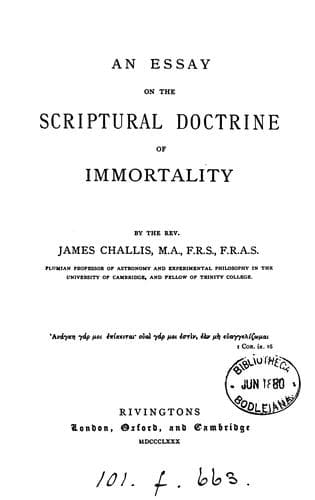
An Essay on the Scriptural Doctrine of ImmortalityChallis, James
Religion
An Essay on the Scriptural Doctrine of Immortality
Challis, James
Immortality
And night shall be no more: and they shall have no
need of light of a lamp, and light of the sun; because the Lord God
will give them light, and they shall reign to the ages of ages" (xxii.
1-5).
The foregoing citations, and indeed the whole tenor of the contents of
the Apocalypse, clearly point to the {110} conclusion that what is
symbolized by "the Lamb" and "the Lamb slain" runs through all it
teaches respecting the course of experience and future destination of
the race of man--is "the lamp" that enlightens the whole. Now, I think
I may assert that the reason this is so is given by the arguments
adduced in this Essay. It has been maintained that on the day that
Adam fell into disobedience by the wiles of Satan, his Creator made a
promise by covenant that he and his offspring should in the end be
freed from the power of Satan and evil, and partake of immortality.
The terms of the covenant were that man must pass through toil, and
pain, and death, that thereby his spirit might be formed for receiving
the gift of an immortal life. Evidence of an intelligent belief of the
efficacy of these conditions was given by the faithful of old by their
sacrificing clean animals, and surety for the fulfilment of the
covenant was given on God's part by a favourable acceptance, either
directly or mediately, of this expression of their faith. In process
of time the only begotten Son of God, out of sympathy with suffering
humanity, and from knowledge of his Father's purpose towards us,
satisfied in his own person the very same conditions, and thus at once
exemplified and justified the means by which that purpose is
accomplished. At the same time he made sure the grounds for belief of
the fulfilment of the covenanted promise, first by marvellous {111}
works before he suffered, which showed that he had command over all the
ills of humanity, and after his death, by resurrection from the grave
the third day, which gave proof of the reality of a power that could
overcome death. The miracles of Christ are an essential part of the
work of his ministry, inasmuch as they were needed to prove that he
possessed power greater than that of his adversaries, and consequently
that he submitted _voluntarily_ to be "led as a _lamb_ to the
slaughter," and to endure all the pain and indignities of the cross.
Out of love towards those whom he vouchsafes to call his brethren, he
showed how they must undergo physical suffering and the pains of death
in order that their spirits might be formed for an endless life. It
was with understanding and belief that the way to life was made sure by
fellowship with Christ in suffering, that some of the most favoured of
his faithful followers, apostles and apostolic men, willingly suffered
after his example.
Public-domain text, read in full here on John Shaqi.
Reviews
Reviews
No reviews yet
Be the first to share your thoughts on this work.
Elsewhere in the archive
Join the Discussion
Join the discussion
Sign in to leave a comment or review.
Sign InorCreate an account