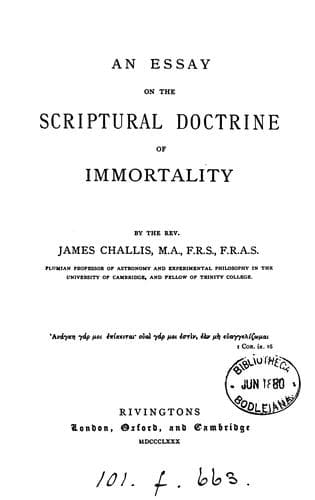
An Essay on the Scriptural Doctrine of ImmortalityChallis, James
Religion
An Essay on the Scriptural Doctrine of Immortality
Challis, James
Immortality
With respect to the interpretation of symbolical Scripture, I have not
abstained from having recourse to books which, although they are not
included in the Canon of Scripture, are specially adapted to reveal
principles on which the prophetical and symbolical parts of Canonical
Scripture may be interpreted. I refer to three books in particular,
the fourth Book of Esdras, the Epistle of Barnabas, and the Shepherd of
Hermas. There is historic evidence that these books were largely made
use of in the days of primitive Christianity. The first has obtained
an honourable place in the Articles of the Church of England, owing, no
doubt, to the traditional influence which the Church of Rome still had
at the time of the Reformation. In the midst of much error and
superstition pervading that Church, she faithfully performed the part
of keeper of the ancient sacred writings, and to her we are indebted
for the preservation for ecclesiastical use of that most instructive
book, although at the Council of Trent it was not admitted into the
Romish Canon. The other two books above mentioned were long regarded
by the Primitive Church as being useful for instruction in doctrine,
and of {121} authority little less than that of Scripture; in
attestation of which assertion it may be stated that the Codex
Sinaiticus contains the whole of the Epistle of Barnabas, and a portion
of the Shepherd of Hermas, although no other early Christian writings
are in the same manner associated with the Canonical Books.
In drawing inferences from the above sources of information, I have
endeavoured to keep closely to the rules of induction which have
conducted to such signal discoveries in Natural Philosophy, and to
refrain from accepting any inference which the Scriptural data did not
justify. The modern advances in physical science, which have shown in
what path we must proceed in order to reach a knowledge of God's works,
indicate, it may be presumed, that an analogous method is to be pursued
in order to gain a knowledge of His word. But it will, perhaps, be
said, that if the knowledge of what is revealed in Scripture be
obtainable only by means such as those which have been exemplified in
this Essay, the considerations that must be entered into are so remote
from common apprehension, that but very few can be supposed to be
endowed with capacity for understanding them. This, it must be
admitted, is actually the case, and, besides, is in conformity with the
arbitrament according to which God grants to an elected few gifts and
graces which He withholds from the many.
Public-domain text, read in full here on John Shaqi.
Reviews
Reviews
No reviews yet
Be the first to share your thoughts on this work.
Elsewhere in the archive
Join the Discussion
Join the discussion
Sign in to leave a comment or review.
Sign InorCreate an account