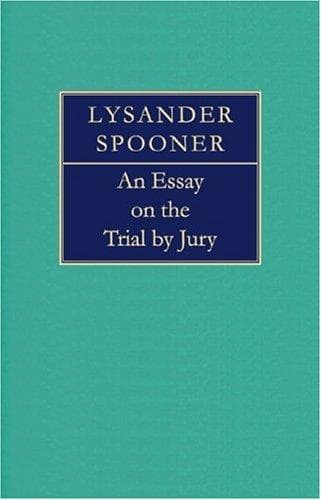
We can all perhaps form some idea, though few of us will be
likely to form any adequate idea, of what a different thing the
trial by jury would have been in practice, and of what would have
been the difference to the liberties of England, for five hundred
years last past, had this prohibition of Magna Carta, upon the
king's officers sitting in the trial of criminal cases, been
observed.
The principle of this chapter of Magna Carta, as applicable to
the governments of the United States of America, forbids that any
officer appointed either by the executive or legislative power,
or dependent upon them for their salaries, or responsible to them
by impeachment, should preside over a jury in criminal trials. To
have the trial a legal (that is, a common law) and true trial by
jury, the presiding officers must be chosen by the people, and be
entirely free from all dependence upon, and all accountability
to, the executive and legislative branches of the government.
[12]
[1] The proofs of this principle of the common law have already
been given on page 120, note.
There is much confusion and contradiction among authors as to
the manner in which sheriffs and other officers were appointed; some
maintaining that they were appointed by the king, others that
they were elected by the people. I imagine that both these
opinions are correct, and that several of the king's officers
bore the same official names as those chosen by the people; and
that this is the cause of the confusion that has arisen on the
subject.
It seems to be a perfectly well established fact that, at common
law, several magistrates, bearing the names of aldermen, sheriff,
stewards, coroners and bailiffs, were chosen by the people; and
yet it appears, from Magna Carta itself, that some of the king's
officers (of whom he must have had many) were also called
"sheriffs, constables, coroners, and bailiffs."
But Magna Carta, in various instances, speaks of sheriffs and
bailiffs as "our sheriff's and bailiffs;" thus apparently
intending to recognize the distinction between officers of the
king, bearing those names, and other officers, bearing the same
official names, but chosen by the people. Thus it says that "no
sheriff or bailiff of ours, or any other (officer), shall take
horses or carts of any freeman for carriage, unless with the
consent of the freeman himself." John's Charter, ch. 36.
Public-domain text, read in full here on John Shaqi.
Reviews
Reviews
No reviews yet
Be the first to share your thoughts on this work.
Elsewhere in the archive
Join the Discussion
Join the discussion
Sign in to leave a comment or review.
Sign InorCreate an account