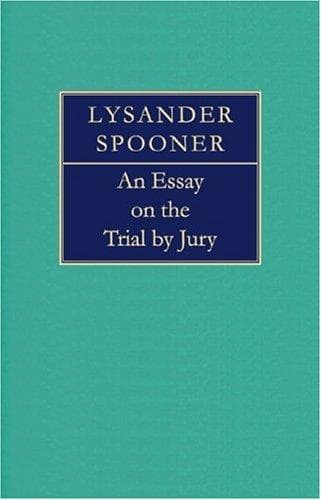
All legitimate government is a mutual insurance company,
voluntarily agreed upon by the parties to it, for the protection
of their rights against wrong-doers. In its voluntary character
it is precisely similar to an association for mutual protection
against fire or shipwreck. Before a man will join an association
for these latter purposes, and pay the premium for being insured,
he will, if he be a man of sense, look at the articles of the
association; see what the company promises to do; what it is
likely to do; and what are the rates of insurance. If he be
satisfied on all these points, he will become a member, pay his
premium for a year, and then hold the company to its contract. If
the conduct of the company prove unsatisfactory, he will let his
policy expire at the end of the year for which he has paid; will
decline to pay any further premiums, and either seek insurance
elsewhere, or take his own risk without any insurance. And as men
act in the insurance of their ships and dwellings, they would act
in the insurance of their properties, liberties and lives, in the
political association, or government.
The political insurance company, or government, have no more
right, in nature or reason, to assume a man's consent to be
protected by them, and to be taxed for that protection, when he
has given no actual consent, than a fire or marine insurance
company have to assume a man's consent to be protected by them,
and to pay the premium, when his actual consent has never been
given. To take a man's property without his consent is robbery;
and to assume his consent, where no actual consent is given,
makes the taking none the less robbery. If it did, the highwayman
has the same right to assume a man's consent to part with his
purse, that any other man, or body of men, can have. And his
assumption would afford as much moral justification for his
robbery as does a like assumption, on the part of the government,
for taking a man's property without his consent. The government's
pretence of protecting him, as an equivalent for the taxation,
affords no justification. It is for himself to decide whether he
desires such protection as the government offers him. If he do
not desire it, or do not bargain for it, the government has no
more right than any other insurance company to impose it upon
him, or make him pay for it. Trial by the country, and no
taxation without consent, were the two pillars of English
liberty, (when England had any liberty,) and the first principles
of the Common Law. They mutually sustain each other; and
neither can stand without the other. Without both, no people have any
guaranty for their freedom; with both, no people can be otherwise
than free. [1]
Public-domain text, read in full here on John Shaqi.
Reviews
Reviews
No reviews yet
Be the first to share your thoughts on this work.
Elsewhere in the archive
Join the Discussion
Join the discussion
Sign in to leave a comment or review.
Sign InorCreate an account