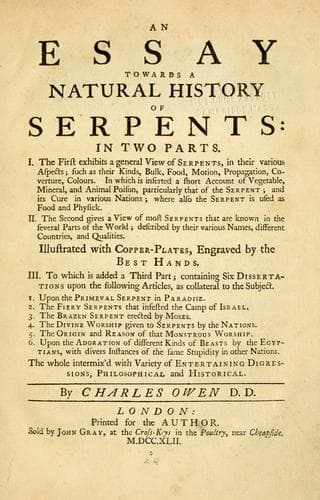
An essay towards a natural history of serpentsOwen, Charles
History
An essay towards a natural history of serpents
Owen, Charles
Serpent worship -- Early works to 1800; Serpents -- Early works to 1800; Serpents -- Religious aspects -- Early works to 1800
The whole is adorned with elegant Variegations.... The Back and Sides
set off with black Spots, inclining to the round; about three Inches
distant from each other, and in the Centre a round white Spot. These
beautiful Appearances, says _Jonstonus_, have a Grandeur in them more
than rivals Imperial Majesty.
He saw several Serpents of this kind: On _August_ 7th, 1638, one that
was eight Foot long. Another, _August_ 13th, 1638, above five Foot long,
its Flesh fat, and very white; the Heart being taken out, lived about 15
Minutes. _October_ 16th, 1638, he saw another, that was near nine Foot
long, and he was a Witness to its swallowing a She-Goat whole[229]. By
the Description, this Serpent must be the _Lyboia_, so famous for the
Knack of Deglutition of Animals.
Footnote 229:
_Jonstoni Historia Naturalis_, p. 25, 26.
XLIII. The _Brasilian Serpent_, called the _Ibiracoan_, makes its
Appearance in a Habit of various Colours, trimmed with red, black and
white Spots. Under this fine Dress, is a poisonous Spring; the Wound it
gives, infallibly kills without immediate Assistance.
Before the Poison reaches the Heart, the common Practice is, to secure
that Serpent, and boil the Flesh of it with certain Roots, and give it
the Patient in Wine, or any other proper Liquid, and it will answer the
Intention.
XLIV. The _Tarciboya_, and _Kakaboya_, are two Serpents much of the same
Nature, and therefore I put them together: They are occasional
Inhabitants of the Water and Land; in Colour black, and about six Hands
in Length. If they hurt any Creature, it is only in Defence of
themselves, and the Wound is easily cured by Remedies well known in
those Countries. They are great Devourers of Birds.
Here the Learned _Ray_, from _Piso_, mentions ten other Serpents, whose
particular Characters he considers in his Description of Fishes; then
refers his Reader to those described by _Joan. de Laet_.[230]
Footnote 230:
_Raii Synopsis Animal._ p. 329. _Londini_ 1693.
XLV. The _Bibera_ is a venemous Lizard of _Brazil_. If you ask, What are
these _Brasilian Lizards_? I answer, They are creeping Serpents, of
various Colours, and different Sizes: Some are the length of a Finger,
others many Feet; have sparkling Eyes. There is only one sort of them
that is venemous, among which is this _Bibera_: they are like the
others, but lesser, and are most mischievous. They are of an ash Colour,
inclining to the white; the Body and Limbs seem thick, but the Tail is
short and broad.
The Wounds given by these Serpents, are full of a thin stinking Matter,
attended with blue Swellings, and Pain in the Heart and Bowels. _N. B._
Great Things have been frequently done by little Things.
Public-domain text, read in full here on John Shaqi.
Reviews
Reviews
No reviews yet
Be the first to share your thoughts on this work.
Elsewhere in the archive
Join the Discussion
Join the discussion
Sign in to leave a comment or review.
Sign InorCreate an account