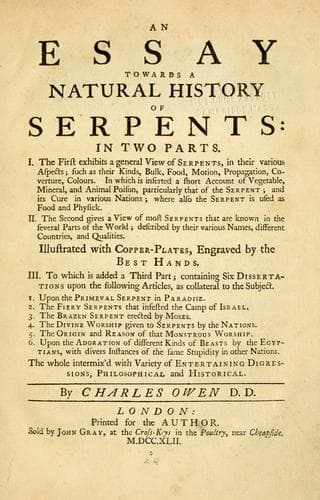
An essay towards a natural history of serpentsOwen, Charles
History
An essay towards a natural history of serpents
Owen, Charles
Serpent worship -- Early works to 1800; Serpents -- Early works to 1800; Serpents -- Religious aspects -- Early works to 1800
It goes under various Appellations. The _Greeks_ called it Guardian of
their Houses[300], it being of the innocent sort. Some of the _Italians_
call it _Carbonarium_, a Collier, because its Colour inclined to
Coal-black, or Iron. Mr. _Ray_ calls it, the _common Snake_. It is
larger than a Viper, and more gross in Body; brings forth its Young by
Eggs, hatch’d by foreign Heat; feeds on Mice; sucks Cows, upon which
follows Blood. The Reader is referred to a former.
Footnote 300:
Οφεις οικουροι.
[Illustration:
_Plate 6^{th}._
]
CXXVIII. The _Marine-Dragon_, as _Pliny_ calls it, or the _true
Marine-Serpent_, in the Dialect of _Jonstonus_, who, in his Description
of Fishes, gives a particular account of it. We have already accounted
for monstrous Serpents in the _Indies_, where some have Teeth in the
form of a Saw, with which they do more hurt than with their Poison, says
the _Greek_ Historian[301].
Footnote 301:
_Æliani Hist._ lib. xvi. cap. 3.
In _Africa_, are some large and strong enough to contend with Oxen by
Land, and to overturn a three-oar’d Galley by Water; which agrees in
Character with those of _Norway_ already described: There we found some
of 200 Foot long, winding themselves about Ships, according to _Olaus
Magnus_, Archbishop of _Upsal_.
In several of the _Persian Islands_ are some of twenty Cubits long, and
very terrifying to Sailors. Such also are seen in the Promontory of
_Carmania_, the Residence of the _Ichthyophagi_, a People that feed
wholly upon Fish; a fine Country for such who are inclin’d to keep a
_perpetual Lent_. Tho’ these Monsters are born in the Deep, yet are they
found in fresh Waters, and sometime sporting upon Land, where they
sleep[302].
Footnote 302:
_Jonston. de Piscib._ p. 9. Articulus v.
The same Author tells us, of a _terrible Battle_ that happen’d in
_Turkey_, in the time of _Bajazet_, between the _land_ and _marine
Serpents_, that continued from Morning to Night, when after a great
Destruction on both sides, the _Marines_ fled. _Ibid._
CXXIX. The _Rubetarian-Serpent_ is a very noisy Animal, who for its
croaking Noise is resembled to a land Toad. It also engages the
Attention of the Eye, for it excels in Beauty: It’s known among Country
People by these two Characteristicks, _viz._ _Loud_ and _Pretty_. Here
we see, what is an Offence to the Ear may be a pleasing Entertainment to
the Eye; thus the Five Senses agree to differ in their several
Perceptions, and to meet in several distinct Apartments of the capital
Temple, in the pacifick Empire. But to return to the _beautiful
Padalica_ of the _Polonians_:
It is said of this Serpent, that when it wounds any in the Foot, the
Remedy is to put the wounded part into the next Earth, that is inclined
to the moist, for twenty-four hours. This seems to differ from the
_American Rubeta_.
Public-domain text, read in full here on John Shaqi.
Reviews
Reviews
No reviews yet
Be the first to share your thoughts on this work.
Elsewhere in the archive
Join the Discussion
Join the discussion
Sign in to leave a comment or review.
Sign InorCreate an account