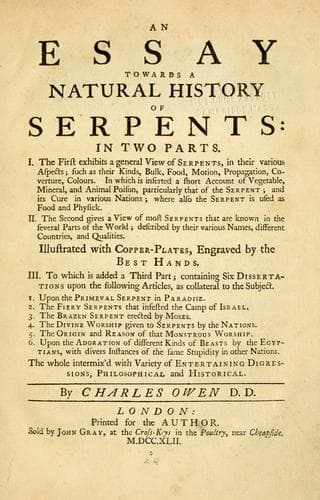
An essay towards a natural history of serpentsOwen, Charles
History
An essay towards a natural history of serpents
Owen, Charles
Serpent worship -- Early works to 1800; Serpents -- Early works to 1800; Serpents -- Religious aspects -- Early works to 1800
What this Serpent was, that triumph’d in Paradise, has been a Subject of
long Debate, and the Learned are not yet agreed in their Verdict about
it. I shall first lay down their various Opinions, and then give my own
Conjectures.
Among the _Jews_, some took it for a real, natural Serpent, and did
believe, it was endued with the Gift of Speaking; but because it
deceived the Woman, was condemn’d to lose its vocal Tongue, _to go upon
its Belly_, and _feed upon Dust_[336].
Footnote 336:
_Joseph. Antiq._ cap. i.
Others, who, not allowing the Privilege of Speech to a Brute, have
turn’d the _Mosaic History_ of Paradise into an _Allegory_, an
Assemblage of Metaphors, or figurative Documents. Thus a certain learned
_Jew_ says, the _Serpent_, that seduced the Woman, _was Pleasure_; and
forbidden Pleasure, when tasted, brought forth Death[337].
Footnote 337:
_Philo Jud. de Mundi Opif._
But if this was the Case, could she be so properly said to be tempted by
another, as to tempt herself? He adds, the Curse of the Serpent is not
only to go upon its Breast, but, _and thou shalt go upon thy Belly_. _q.
d._ “Since Pleasure was thy Desire, let the Pleasure of the Earth enter
into it. The _Belly_, says the _Allegorizer_, is the Receptacle of most
Pleasures of the Animal Kind.” Creatures that go upon four Feet, or
more, are deem’d impure; and such is he, who is a Lover of terrene
Pleasures; such a Person may be said, always to go upon his Belly,
because he studies nothing more than its Gratification. Pleasure indeed,
is attended with a Train of Allurements and Charms. _Tarquin_’s violent
Pursuit of forbidden Pleasure, terminated, not only in the Ruin of his
House, but Extirpation of Monarchy: _Crœsus_ King of _Lydia_ being
conquer’d by _Cyrus_ King of _Persia_, gave the Conqueror this Advice,
If you would have the _Lydians_ be your obedient Slaves, make them
_Slaves to Pleasure_.
Nor is _Philo_ alone in making the Serpent a Symbol of Pleasure, for
_Maimonides_ and others expound those historical Passages in the same
manner; asking, Why should that Serpent be call’d a subtle Beast, if it
were not in a figurative Sense? In favour of this Exposition, he quotes
several Passages out of the Prophets, that are allow’d to be intirely
allegorical[338]; and then adds, that in _Moses’s Journal of the
Creation_, all things therein are not to be understood literally[339].
One of the most learned Fathers seems inclined to this _Philonick
Interpretation of Moses_[340]. It is observable, that in reality, ’twas
not the _Pleasure of Eating_ which tempted the Woman, but an anxious
_Desire of greater Wisdom_; which shews a more refined Taste in _Eve_,
and overthrows the Hypothesis of _Philo_ and _Clemens_.
Footnote 338:
_More Nevochim_, cap. xxix.
Footnote 339:
Ibid. p. 265, & 273.
Footnote 340:
_Clem. Alexandrinus_, who flourish’d in the second Age. Οφις
αλληγορειται—ηδονη. Edit. col. p. 69. A. B. _A. D._ 1688.
Public-domain text, read in full here on John Shaqi.
Reviews
Reviews
No reviews yet
Be the first to share your thoughts on this work.
Elsewhere in the archive
Join the Discussion
Join the discussion
Sign in to leave a comment or review.
Sign InorCreate an account