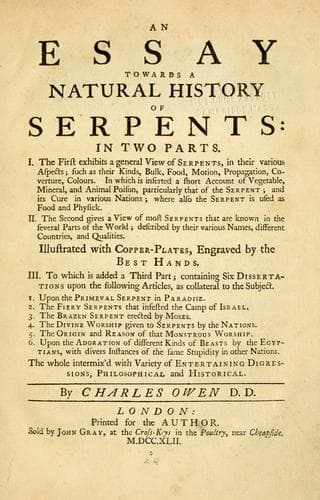
An essay towards a natural history of serpentsOwen, Charles
History
An essay towards a natural history of serpents
Owen, Charles
Serpent worship -- Early works to 1800; Serpents -- Early works to 1800; Serpents -- Religious aspects -- Early works to 1800
God appear’d to _Moses_ under the Form of a Fire burning in a Bush. The
Camp of _Israel_ in the Wilderness was conducted in the Night by a
Pillar of Fire. Now God having made several Revelations of himself,
under the Appearance of Fire, might give occasion to the _Chaldeans_ and
_Persians_ to entertain such enormous Veneration for Fire, which is a
Symbol of the Deity: _The Lord thy God_, says _Moses, is a consuming
Fire_. At their high Solemnities they set several Trees (hung with
diverse Sorts of Beasts for Sacrifice) on fire; this they did after they
had carried about these Fires in Procession.
I Shall add here, a remarkable Contest that happen’d between the
_Chaldean_ and _Egyptian_ Priests about the _Superiority of their
Gods_.... In the time of _Constantine_ the _Chaldean Priests_, to prove
that _Fire_, which was their God, excell’d all other Gods in Power,
travell’d over the Earth, carrying _Fire_ with them, which soon consum’d
all the Statues and Images of other Gods; whether of Brass, Silver,
Stone or Wood, says _Suidas_[386], who gives a large Account of it,
under the Word κανωπος. At length coming into _Egypt_, and making this
Challenge; the _Egyptian Priests_ agreed upon a _Battle of the Gods_,
and immediately brought into the Field one of their Idols, which was a
large Statue of _Nilus, full of Water_, and full of little Holes, which
they stopt with Wax not discernable, and so artificially, that the Water
was kept in.
Footnote 386:
Vol. I. pag. 1368.
The _Chaldeans_ (not aware of this Device) begun the Action, with much
Assurance, and with Eagerness put Fire around the _Egyptian Statue_,
which soon melted the invisible Wax, and the Water gushing forth from
all Parts, immediately put out the Fire, and drown’d the hitherto
_invincible Deity_ of the _Persians_; the Tragedy ended in a triumphant
Shout of Laughter among the Spectators: And I might add[387] how the
_Arabians_ and _Indians_, _Peruvians_, _Lithuanians_, and _Vandals_
worship’d Vegetables,—the _Scythians_ Iron. Trees and Plants have been
made Gods. Leeks and Onions were Deities in _Egypt_. The ancient _Gauls_
and _Britons_ bore a particular Devotion to the _Oak_; from which their
Priests took their Names. _Ceres_ and _Proserpina_, worship’d by the
Ancients, were no other than Wheat, Corn, Seed.—The _Syrians_ and
_Egyptians_ ador’d Fishes. What were _Tritons_, _Nereids_, _Syrens_, but
Sea-Gods? Insects, as Flies, and Ants, had their Priests and Votaries:
Yea, _Minerals_ were erected into _Deities_. The _Finlanders_ ador’d
_Stones_. I don’t see what can be said for such an Instance of
Stupidity. To say the Practice took its rise from _Abram_’s anointing
the _Stone_ that he made use of for a Pillow, when he went to
_Mesopotamia_, does not lessen the Reproach. The _Mahometans_ think that
_Jacob_’s Stone was convey’d to the _Temple at Jerusalem_; and is still
there in a _Mosque_ or _Turkish_ Temple, where the Temple at _Jerusalem_
stood before the final Desolation.
Public-domain text, read in full here on John Shaqi.
Reviews
Reviews
No reviews yet
Be the first to share your thoughts on this work.
Elsewhere in the archive
Join the Discussion
Join the discussion
Sign in to leave a comment or review.
Sign InorCreate an account