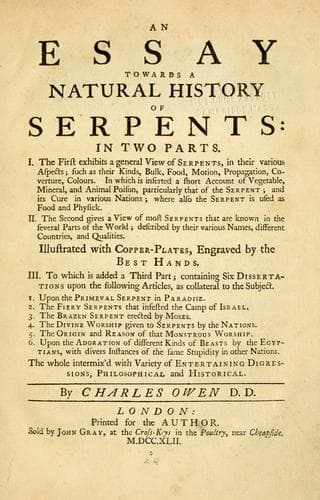
An essay towards a natural history of serpentsOwen, Charles
History
An essay towards a natural history of serpents
Owen, Charles
Serpent worship -- Early works to 1800; Serpents -- Early works to 1800; Serpents -- Religious aspects -- Early works to 1800
The _English_ Cosmographer accounts for them thus, _viz._ “The People
anciently had _Fire_ and _Serpents_ for their Gods, nourishing the last
in their Houses, and keeping the other continually burning; the Priests
of the Temple always adding Fuel, that it might not fail. The Vestal
Fire was not kept more carefully at _Rome_, nor with greater
Ceremony.... To this God, (whom they call’d, Lord of the _Smoke_,) they
used to sacrifice young Pullets, to the other their Cocks[412].” The
Seed of this Idolatry is so implanted in them, that ’tis said, that in a
Village of the King’s, called _Lovaniski_, their chief City, they do, to
this day _worship Serpents_. _ibid._
Footnote 412:
_Heylin_’s Cosmogr. lib. 2. _Poland_ p. 143.
The _Lithuanians_, ’tis said, ador’d three Gods, _Fire_, _Wood_, and
_Serpents_. These last were counted their _Guardian Gods_. And according
to a certain Historian, this kind of superstitious and diabolical
Worship continues yet in some Parts of the Kingdoms of _Norway_ and
_Vermolandia_[413].
Footnote 413:
_Olaus Magnus_, Archbishop of _Upsal._ History of the _Goths_.
The Inhabitants of _Prussia_ were barbarous and wild in the highest
degree, having of old no manner of Religion, or next to none, and first
began _with the Worship of Serpents_[414]. There are Countries in the
_Indies_, says _Jurieu_, where Serpents are worship’d to this day.
Footnote 414:
_Erasm. Stella_ in the Antiquities of _Prussia_. Lib. 1.
_ARISTOPHANES_, in the Comedy entitled _Plutus_, observes that the Deity
gave the Sign, _viz._ by _hissing_; upon which two monstrous Dragons
skip’d out of the Temple[415].
Footnote 415:
Δυω δρακοντ’ εκ του νεω. Fragmenta p. 52.
Dixerat hæc adytis cum lubricus anguis ab imis.
When _Æneas_ sacrificed to the _Manes_, (the departed Soul) of his
Father _Anchises_, he saw a _Serpent_ come out of his Grave, which he
concluded to be either the _Tutelar God_ of his Father, or of that
Place, which was counted a good Omen. We have an Account of some Priests
in _Asia_ that expose to publick View a Serpent in a brazen Vessel,
attended with a great Variety of Musick. The Serpent appears in an erect
Posture, opens its Mouth, and instead of a forked Tongue, appears the
Head of a beautiful Virgin[416].
Footnote 416:
_Phil. Melanchton._
_NICHOLAS de Lyra_ makes mention of such another idle Conceit, _viz._
That the Serpent assumed the Face of a beautiful Maid, when it tempted
_Eve_. _N. B._ In the _German Bibles_ printed before _Luther_, among
other Figures may be seen that of a Serpent with the Face of a very
handsome Maid.
In short, so great was the Devotion paid to Serpents, that Persons and
Things were denominated from them: Yea, some would be thought to proceed
from Serpents, as the highest Degree of Honour. _Cadmus_’s Companion was
called a _Serpent_, so the Giant in _Homer_, and a certain Prophet in
_Pausanias_.
Public-domain text, read in full here on John Shaqi.
Reviews
Reviews
No reviews yet
Be the first to share your thoughts on this work.
Elsewhere in the archive
Join the Discussion
Join the discussion
Sign in to leave a comment or review.
Sign InorCreate an account