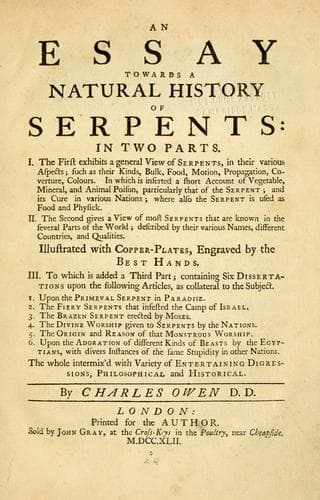
An essay towards a natural history of serpentsOwen, Charles
History
An essay towards a natural history of serpents
Owen, Charles
Serpent worship -- Early works to 1800; Serpents -- Early works to 1800; Serpents -- Religious aspects -- Early works to 1800
_Lowthorp_’s _Philosoph. Transactions abridged_, vol. iii. p.
10, 12. Edit. 2. Communicated by Mr. _Thoresby_, N. 256. p.
332. 1699. In Page 10. an account is given of the wonderful
Effects of Touch and Friction.
IV. The _Hemorrhous_ Serpent is an _Egyptian_ of the viperine kind; of
sandy and bright Colour, enamel’d with black and white Rays on the Back;
flaming Eyes, corniculated Brows, and is defended by an Armature of
rough and sharp Scales; which by one is given as the Reason of making
some Noise as it goes, which another denies, because it wants the
_Sonalia_[112].
Footnote 112:
_Caret Sonalibus._ _Nierembergius_, p. 269.
This Creature is little in Body, but great and terrible in its
Executions; for when it wounds any Persons, all the Blood in the Body
flows out, at all the Apertures of it, which is immediately follow’d
with Convulsions and Death[113].
Footnote 113:
_Gyllius_, p. 261. _Raii Synopsis Meth._ 8vo. A. D. 1693. _Invenitur
in Ægypto & aliis locis quibus Thonis imperavit._ _ibid. & in agris
Jucatensibus_.
At non stare suum miseris passura cruore
Squamiferos ingens Hæmorhois.
The _Atlas_ from _Ribeyro_ mentions an _Indian Serpent_ of the same
malignant Nature, whose Poison operates with such Violence, that the
Person wounded by it bleeds at the Eyes, Nostrils, Ears, and all the
Pores of the Body, and the miserable Patient is irrecoverable.
The Poet laments the Death of the _brave and noble Tullus_[114], by this
bloody Serpent; which is also found in _India_ (according to _Diodorus
Siculus_) in that part where _Alexander_ the _Great_ conquer’d _Porus_,
the _Great_ King of the _Indies_. The Conqueror bid _Porus_ ask of him
whatever he desired; who answered, _That he only desired to be treated
as a Prince_: with which _Alexander_ was so charm’d, that he not only
gave him his Kingdom again, but some of the Provinces he had conquered
in that Vicinity.
_N. B._ On the Bank of the River _Hydaspis_, _Alexander_ built a Town,
which he call’d _Bucephala_, in remembrance of _Bucephalus_ his great
Horse, which died and was buried there.
Footnote 114:
_Lucan_, lib. ix. p. 269. _Impressit dentes Hemorhois aspera Tullo
magnanimo Juveni._
V. The Serpent _Seps_, which by some is said to be the same with
_Sepedon_, is about two Cubits long, the Head broad, and of divers
Colours. Both these are of the smaller Species, but most venemous, and
therefore are rank’d in the second Class of Serpents. The Virulency of
the Poison is not in proportion to their diminutive Stature.
When any are wounded by these venemous Animals, the Hair of the Head
immediately falls off, the whole Body turns scurfy, leprous and putrid;
yea, the very Bones, as well as the Flesh, putrify and corrupt;
therefore some call it the _putrid Serpent_[115]. The Poet accounts for
the Symptoms of its Poison[116].
Footnote 115:
_Nonnulli ex Scoligero, non male putriam vocare._ _Jonstonus_, p. 14.
Public-domain text, read in full here on John Shaqi.
Reviews
Reviews
No reviews yet
Be the first to share your thoughts on this work.
Elsewhere in the archive
Join the Discussion
Join the discussion
Sign in to leave a comment or review.
Sign InorCreate an account