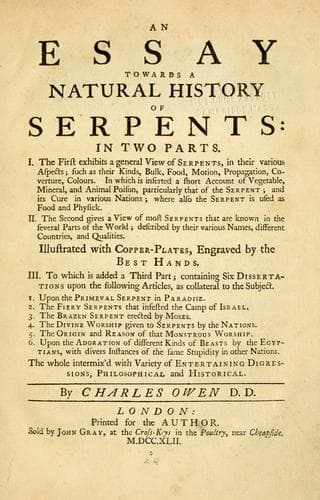
An essay towards a natural history of serpentsOwen, Charles
History
An essay towards a natural history of serpents
Owen, Charles
Serpent worship -- Early works to 1800; Serpents -- Early works to 1800; Serpents -- Religious aspects -- Early works to 1800
“When touch’d by a Rod from that Tree, they are immediately
intoxicated, but so as to be able to follow the Motion of the
Rod; but whether by reason of some great Disproportion or
Incompossibility, between these subtile Effluvia and the
Temperament of the vital, spiritual Substance of the Serpent, or
by what other way, we are not told[131]. The Sassafras-tree, a
Native of _America_, is call’d _Cornus_ also, whose Wood is very
odorous and fragrant.”
Now, say these Gentlemen why should it seem impossible, that he who
understands this invincible Enmity, and how to manage a Rod of the
_Cornus_ with Cunning and Dexterity (having first intoxicated a Serpent
by the Touch thereof) should during that Fit make it observe, and
readily conform to all the various Motions of the Wand, so as that the
unlearned Spectators, perceiving the _Serpent_ to approach the
_Inchanter_, as he moves the Wand near to himself, or to retreat from
him, as he put the Wand from him, or turn round and dance as the Rod is
mov’d to and fro, or lie still as in a Trance, as the Rod is held still
over it; and all this Time, the People knowing nothing of the Virtue in
the Rod, are easily deluded into a Belief, that the whole Scene is
supernatural, and the main Energy radiated in those Words or Charms,
which the Impostor with great Ceremony and Gravity of Aspect mutters
forth, the better to disguise his Legerdemain, and dissemble Nature in
the colour of a Miracle.
Footnote 131:
_Charlton._
The Rattle-snakes in _America_ are said to secure their Prey by
Incantation; for they have the Power or Art, (I know not which to call
it, says my Author) to charm Squirrels, Hares, Partridges, or any such
Thing, in such a manner, that they run directly into their Mouths: This
I have seen, adds he, by a Squirrel and one of the Rattle-snakes; and
other Snakes have in some measure the same Power[132].
Footnote 132:
Natural History of _Carolina, A. D. 1711_. page 129.
It is allowed indeed, that there are _dumb Creatures_ that do exceed Man
in some _sensible Perceptions_, particularly in that of _Smelling_, as
the _Harriers_, and other Dogs. How strange, that Odours from the Hare’s
Body, Should so affect the Nose of a Hound, as to raise in him that
Sensation or Scent, by which he follows her all the Day (tho’ he never
had a Sight of her) thro’ a Cloud of Opposition, from perplexing
intricate Places, and Effluviums proceeding from other Animals!
These Emanations are exceeding fine Effluvia, or Particles flying off
odorous Bodies in all Directions; and as they float in the Air on the
Surface of the Earth (within their Atmosphere) strike against the Dog’s
Nose, and produce that Sensation of Smell.—_N. B._ The Intensity of
Smell in all Creatures, is in proportion to the Density or Thickness
where we are: This Density is always diminish’d in proportion to the
Squares of the Distances from the odorous Body.
Public-domain text, read in full here on John Shaqi.
Reviews
Reviews
No reviews yet
Be the first to share your thoughts on this work.
Elsewhere in the archive
Join the Discussion
Join the discussion
Sign in to leave a comment or review.
Sign InorCreate an account