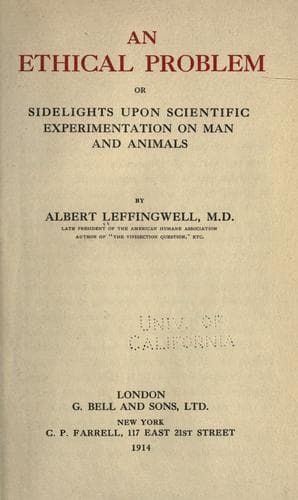
An ethical problem; or, Sidelights upon scientific experimentation on man and animalsLeffingwell, Albert
Philosophy
An ethical problem; or, Sidelights upon scientific experimentation on man and animals
Leffingwell, Albert
Medicine, Experimental; Vivisection
It is interesting to compare these assertions with the testimony given
by another physiologist--Dr. Pembrey, the lecturer on physiology at
Guy's Hospital in London. He tells the Commission that "a common-
sense view should be taken of the question," and then makes a definite
admission that by no means bears out the contention of the
physiologist of University College. "I ADMIT," said Dr. Pembrey, "THAT
I HAVE DONE PAINFUL EXPERIMENTS, and I am not ashamed of admitting
it." He goes yet further, declaring that if you caused an animal to
suffer extreme agony, the pain itself might be so severe as to render
the creature unconscious. It is probable that the physiologist could
not have foreseen the results of his candid admissions. When the
Commission made their final report, they expressed unanimously the
opinion that "to grant a licence to any person holding such views as
those formerly expressed by Dr. Klein and as those entertained by
Dr. Pembrey is calculated to create serious misgiving in the mind of
the public."
Closely allied to this question is the problem of anaesthesia. Fifty
years ago ether and chloroform were administered to animals very much
as they were given to human beings undergoing operations in surgery.
An animal returning to consciousness gave abundant evidence of its
sensibility to suffering by its struggles and cries. The experimenter
might try to believe that the pain was slight, but he never disputed
its existence. To-day, all this is changed. As much or as little of
the anaesthetic may be given as the vivisector desires, and yet he may
declare that "ANAESTHETICS WERE USED," no matter how slight the degree
of sensibility thus induced. It is a known fact that a dog is very
susceptible to the action of chloroform, so that during its
administration death frequently occurs. Sir Thornley Stoker, the
President of the Royal Academy of Medicine in Ireland, and for many
years a teacher of science, testified before the Commission that a
dog's heart is very weak and irregular, and susceptible to the
poisonous influence of chloroform. Over and over again he expresses
the doubts that arise concerning the administration of chloroform. "I
fear that, particularly in the case of dogs, ANAESTHESIA IS NOT ALWAYS
PUSHED TO A SUFFICIENT EXTENT, as these animals often die from the
effects of the anaesthetic if given to a full extent.... I am never
sure, if I give a dog chloroform, that I will not kill it.... THE
ANAESTHESIA CANNOT BE COMPLETE if the dog lives as long as is
necessary for some of these experiments." Even for one hour he
believes it would be generally impossible to keep a dog alive under
full anaesthesia. On the other hand, Dr. Starling declared that
"there is no difficulty in keeping an animal alive as long as you
like," and Sir Victor Horsley affirmed that one could keep a dog
under chloroform "FOR A WEEK, if you only take the trouble."[1]
[1] See Minutes of Evidence, November 13, 1907, Q. 15,649.
Public-domain text, read in full here on John Shaqi.
Reviews
Reviews
No reviews yet
Be the first to share your thoughts on this work.
Elsewhere in the archive
Join the Discussion
Join the discussion
Sign in to leave a comment or review.
Sign InorCreate an account