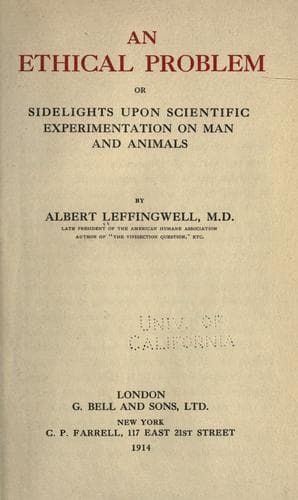
An ethical problem; or, Sidelights upon scientific experimentation on man and animalsLeffingwell, Albert
Philosophy
An ethical problem; or, Sidelights upon scientific experimentation on man and animals
Leffingwell, Albert
Medicine, Experimental; Vivisection
That chloroform or ether will suppress the consciousness of pain
during a surgical operation, every reader is aware. But when we speak
of certain vivisections, we are on different ground. The pains to be
inflicted are sometimes far more excruciating than any surgical
operation. In the stimulation of sensory nerves, and in various
operations upon these nerves, there may be excited agonies so great
that they break through the limited unconsciousness induced by
chloroform. One of the most experienced vivisectors in America has
given his testimony on this point. Speaking of his experiments upon
some of the most exquisitely sensitive nerves, Dr. Flint says: "WHEN
we have used anaesthetics"--not the significance of the phrase--"WE
COULD NEVER PUSH THE EFFECTS SUFFICIENTLY TO ABOLISH THE SENSIBILITY
OF THE ROOT OF THE NERVE. If an animal, brought so fully under the
influence of ether that the conjunctiva had become absolutely
insensible" (the degree of insensibility required by the surgeon),
"the instant the instrument touched the root of the nerve in the
cranium, THERE WERE EVIDENCES OF ACUTE PAIN."[1] Of other experiments
upon the same nerves he tells us that "in using anaesthetics, we have
never been able to bring an animal under their influence SO COMPLETELY
AS TO ABOLISH THE SENSIBILITY.... In cats that appear to be thoroughly
etherized, as soon as the instrument touches the nerve, there is more
or less struggling."[2]
[1] Flint's "Physiology," vol. iv., p. 97.
[2] Flint's "Physiology," vol. iv., p. 193.
This statement needs to be remembered. The agony may be so keen, so
exquisite, so far beyond the pain of a surgical operation, that it
makes itself felt. Pain, then, conquers the anaesthetic, exactly as
the anaesthetic usually conquers the pain.
What, then, is the value of the phrase, "ANAESTHETICS WERE USED"?
Dr. Hoggan has told us. It has no value whatever.
Sir Thornley Stoker, President of the Royal Academy of Medicine in
Ireland, and an inspector of laboratories under the Act, was
questioned about the pain endured by an animal in course of a
prolonged vivisection, and he frankly admitted that a vivisector
"could do no more than give an opinion. He could have no CERTAINTY as
to the entire absence, the continuous absence, of pain."[2] Dr. Thane,
a professor at University Medical College, London, and a Government
inspector, being asked whether one might not be able to distinguish
between painful and painless experiments, replied that "the inspector
never could distinguish exactly which experiments were painless and
which were painful, AND THE EXPERIMENTERS AND OBSERVERS THEMSELVES
cannot distinguish IN A VERY LARGE NUMBER OF CASES."[3]
[2] Evidence before Royal Commission, Question 1,064.
[3] Ibid., Question 1,335.
Public-domain text, read in full here on John Shaqi.
Reviews
Reviews
No reviews yet
Be the first to share your thoughts on this work.
Elsewhere in the archive
Join the Discussion
Join the discussion
Sign in to leave a comment or review.
Sign InorCreate an account