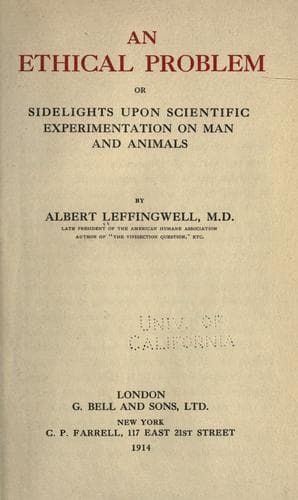
An ethical problem; or, Sidelights upon scientific experimentation on man and animalsLeffingwell, Albert
Philosophy
An ethical problem; or, Sidelights upon scientific experimentation on man and animals
Leffingwell, Albert
Medicine, Experimental; Vivisection
The principal point toward which inquiry must be directed is the
question of pain. One reason why they have been partly condoned by
the public is not difficult to discover. In language which seemed to
have no element of ambiguity, the experimenter apparently affirmed the
entire absence of sensation on the part of the dogs which he and his
assistants subjected to operations of various kinds and of an extreme
character. It is true that, as a general rule, this affirmation was
not as explicit as might perhaps be desired. He was writing for
professional men only, not for the general public, and it is quite
unlikely that any physiologist or medical reader could have been at
any time misled in the slightest degree. If the language used was
capable of more than one interpretation, if possibilities of
insensibility were exaggerated into definite assertions, nothing of
the kind was apparent to the general reader. Glancing at the
statement that "the animals were completely anaesthetized," his doubts
were abolished. Indescribably disgusting and hideous as were some of
the vivisections, if they were absolutely painless, their performance
was a matter of taste. Can we criticize the humaneness of one who, at
the butcher's bench, mutilates the body from which life has gone?
Complete and perfect anaesthesia, maintained till death, is
practically only premature death. Deprived of sensibility--a
deprivation that is never to cease--a living creature is beyond the
infliction of cruelty. But is it certain that all these various
experiments, made upon nearly five hundred dogs were without pain?
Reasons for doubt concerning some of them have been given. Let us now
look into the question so far as concerns vivisection in its relation
to the pressure of the blood.
A little over two centuries ago the Rev. Stephen Hales, the rector of
an obscure country parish in England, became interested in problems
pertaining to the circulation of sap in plants, and blood in the
higher animals. By various experiments he discovered that the blood
of a living animal is subject to a definite pressure, and with some
approach to accuracy he succeeded in measuring it. The subject seems
to have attracted but little attention for over a century after the
discovery of Hales; it was then again investigated by physiologists,
and certain conclusions definitely reached. Without going into the
subject at length, it suffices to state that this blood-pressure
constantly varies slightly, being somewhat influenced by every
disturbing condition, and probably by every physiological act. Any
injury tending to lower the tone of the general system, or to induce
the condition of shock, tends to cause the blood-pressure to fall. On
the other hand, if the animal is sensible to pain, the stimulation of
sensory nerves, or any sharp or sudden pang, TEND TO CAUSE A RISE IN
THE PRESSURE OF THE BLOOD, unless the creature has become exhausted by
the experimentation to which it has been subjected.
Public-domain text, read in full here on John Shaqi.
Reviews
Reviews
No reviews yet
Be the first to share your thoughts on this work.
Elsewhere in the archive
Join the Discussion
Join the discussion
Sign in to leave a comment or review.
Sign InorCreate an account