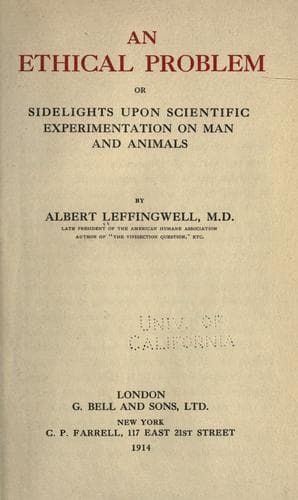
An ethical problem; or, Sidelights upon scientific experimentation on man and animalsLeffingwell, Albert
Philosophy
An ethical problem; or, Sidelights upon scientific experimentation on man and animals
Leffingwell, Albert
Medicine, Experimental; Vivisection
In the year 1909 the same vivisector published stll another volume
recording experiments upon haemorrhage and the transfusion of blood.
To many of these experiments we should take no exception on the ground
of inutility or excessive production of pain. Others, however, are to
be criticized, particularly when studied in connection with the claim
put forth of complete absence of animal sensation. In his
introduction the experimenter seems to assert in the most distinct and
emphatic way the complete unconsciousness of each victim. He says:
"No experiment was performed in which the particular animal used was
not reduced to complete insensibility by means of ether, or some other
equally efficient anaesthetic. If the statement is made that the
anaesthetic was stopped during an experiment, it does not mean that
the animal could suffer pain, but that death was threatened from too
much anaesthetic, more being given as soon as signs of revival were
shown. In every experiment in which necessary mutilation was
performed, the animal was killed before coming out of the anaesthetic;
therefore absolutely no suffering was undergone. Very few recovery
experiments were performed, no more than were necessary to prove a
given fact."
What is the scientific value of this assurance--that "absolutely no
suffering was undergone"?
It can have no value, except as an opinion on the part of one
extremely interested in the maintenance of a particular view. So far
from being a series of painless experiments, we do not hesitate to
suggest that IF RISE OF BLOOD-PRESSURE BE A SIGN OF PAIN, then, in all
probability many of them involed torments as exquisite as it is
possible to imagine.
Take, for example, the folloowing vivisections:
EXPERIMENT 10. The subject was a dog, said to be in a good
condition. From time to time blood was abstracted from the body.
4.26. ON BURNING A PAW UNDER LIGHT ANAESTHESIA, THERE WAS A RISE OF
PRESSURE OF 16 MILLIMETRES.
10.16. On burning a paw, there was A RISE OF PRESSURE.
11.13. On burning a paw, there was A RISE OF PRESSURE of
13 millimetres.
1.42. On burning a paw, there was A RISE OF PRESSURE of
13 millimetres.
EXPERIMENT 33. "ON BURNING A PAW UNDER LIGHT ANAESTHESIA, THERE WAS A
RISE OF PRESSURE OF 19 MILLIMETRES."
What is "LIGHT anaesthesia"?
Public-domain text, read in full here on John Shaqi.
Reviews
Reviews
No reviews yet
Be the first to share your thoughts on this work.
Elsewhere in the archive
Join the Discussion
Join the discussion
Sign in to leave a comment or review.
Sign InorCreate an account