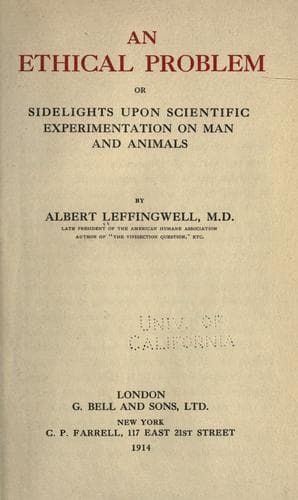
An ethical problem; or, Sidelights upon scientific experimentation on man and animalsLeffingwell, Albert
Philosophy
An ethical problem; or, Sidelights upon scientific experimentation on man and animals
Leffingwell, Albert
Medicine, Experimental; Vivisection
If a vast number of the experiments recorded may have involved the
keenest agony of the victims, how are we to explain the repeated
assertions that sensation was absolutely removed? Among
antivivisectionists there are those who belive that any human being
who could thus subject animals to torment would not find it impossible
to deny the fact. Such explanation implies an inveracity which it is
not necessary to impute. Mankind is still liable to error; the false
deductions of honest men have more than once led to mistaken
affirmations of facts; and the most illustrious scientist that ever
lived can hardly claim infallibility in matters of opinion. A
distinguished philosopher and vivisector of three hundred years ago,
Rene Descartes, put forth the theory that animals, being without
souls, cannot suffer pain, and that their cries under vivisection were
simply as the whirring of wheels in an intricate piece of machinery.
We can easily imagine a modern follower of Descartes declaring, as the
philosopher would have done, that "NO SUFFERING WAS FELT." A professor
of physiology in Harvard Medical School, in course of an address
before a State medical society, laid down the theory that "it is
ENTIRELY IMPOSSIBLE to draw conclusions with regard to the sensations
of animals by an effort to imagine what our own would be under similar
circumstances"; and when a vivisector has reached the stage where he
can hold that belief, he may define pain as something pertaining only
to human beings, and feel himself justified in declaring that
"VIVISECTION OF ANIMALS NEVER CAUSES PAIN," according to his
definition of the word. It is well for the world that with this
theory the vast majority of thinking men and women have no sympathy
whatever. The organized efforts for the protection of animals from
cruelty have no meaning if animals are without capacity for that
anguish which cruelty implies. We believe, on the contrary, that
many, if not all, of the higher species of animals, especially those
nearest to man in structure and intelligence, receive, when subjected
to the torment of fire or steel, precisely the same sensations that,
under a like infliction, a human being would suffer. At any rate, if
doubt be possible, should they not have the benefit of it?
Public-domain text, read in full here on John Shaqi.
Reviews
Reviews
No reviews yet
Be the first to share your thoughts on this work.
Elsewhere in the archive
Join the Discussion
Join the discussion
Sign in to leave a comment or review.
Sign InorCreate an account