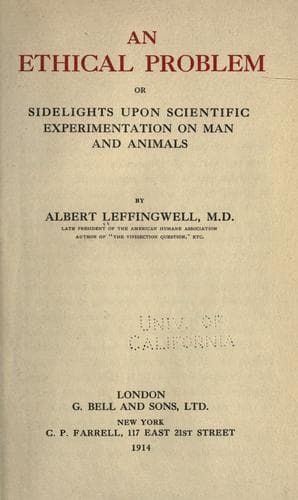
An ethical problem; or, Sidelights upon scientific experimentation on man and animalsLeffingwell, Albert
Philosophy
An ethical problem; or, Sidelights upon scientific experimentation on man and animals
Leffingwell, Albert
Medicine, Experimental; Vivisection
human being undergoing the experiences of some of the animals that
slowly die in a laboratory." So wrote Dr. Bigelow of Harvard
University, the most eminent surgeon that New England has yet
produced; and were he living to-day, it is not improbable that he
would point to some of the experiments here reviewed as examples of
the vivisections he intended to condemn. It may be that although the
present generation be indifferent, posterity will not condone, and
that one day it will hold up some of the experiments of the twentieth
century as involving the most prolonged, the most useless, the most
terrible, the most cruel torments, that the annals of animal
vivisection have ever supplied.
CHAPTER XIII
WHAT IS VIVISECTION REFORM?
Every reflecting man must recognize that the settlement of the
vivisection question is a problem that must find its solution at some
period in future rather than to-day. But the duty of the hour remains
the same. Admitting the existence of the wrong, what can we do to
promote reform? What should we ask with the hope that popular judgment
will gradually come to approve? How may we be faithful to that ideal
of justice toward our inferior brethren, which underlies all
humanitarian effort, and lack nothing in fidelity to Science to whose
achievements we reverently look for the amelioration of the human
race? There are those who would oppose the slightest use of animals
for any scientific purpose whatever. There are others who would grant
to the vivisector the secrecy and silence, the complete
irresponsibility and unbounded freedom which he demands as his right.
There are those to whom a middle course seems the only one leading to
ultimate reform. What is the most reasonable attitude toward the
laboratory and its claims possible to an honest and clear-minded
investigator who is anxious to protect all living creatures from cruel
acts, and equally concerned in the conservation of every legitimate
privilege which Science can claim?
Such a man stands, let us say, before some great biological
laboratory, richly endowed, slendidly equipped, and in the present
enjoyment of freedom that is without bounds, and in a secrecy that
to-day is as complete as can be imagined. What can he learn with
certainty of what goes on within? If he hears claims of superlative
gains by the experiments there carried on, how is he to weigh and
decide their value? If there is cruelty behind those barred doors, how
is he to prevent its constant recurrence? What, in short, should be
the reasonable attitude of every intelligent man or woman anxious to
know the truth and to promote reform of abuse?
Public-domain text, read in full here on John Shaqi.
Reviews
Reviews
No reviews yet
Be the first to share your thoughts on this work.
Elsewhere in the archive
Join the Discussion
Join the discussion
Sign in to leave a comment or review.
Sign InorCreate an account