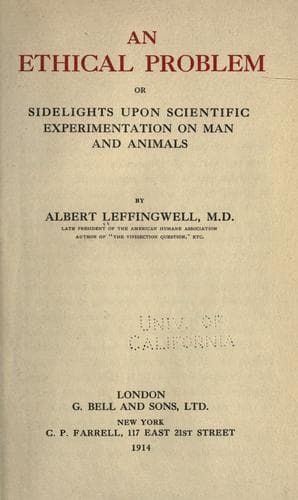
An ethical problem; or, Sidelights upon scientific experimentation on man and animalsLeffingwell, Albert
Philosophy
An ethical problem; or, Sidelights upon scientific experimentation on man and animals
Leffingwell, Albert
Medicine, Experimental; Vivisection
One method of obtaining information concering the practice in America
is through a Legislative commission. Guided intelligently, such a
Commission should be able to present in its final report a large
accumulation of important facts. It is evident, however, that if such
disclosures are likely to tell against present methods of research,
the appointment of any such Commission will be strenuously opposed by
everyone connected with the laboratories. The strange thing is that
precisely this opposition has been evinced in the State of New York,
as elsewhere shown. The powers that control prefer the present
darkness, and for the time being have been able to secure it. But
this very opposition is so significant that no effort should be
relaxed to bring every phase of the practice of vivisection into the
light of day.
That altogether too much reliance may be placed upon Government
inspection of laboratories seems unquestionable. If one could be sure
that it would always be conducted by intelligent and educated men,
with due appreciation of scientific aims, yet in thorough sympathy
with humane motives and objects, it would undoubtedly be of use. But
no such reliance can be ours. The experience of England should convey
a lesson in this respect.
Suppose, therefore, that in place of demanding the State inspection of
laboratories, or any present interference with the conduct of the
vivisector, we endeavor first of all to learn the facts through the
experimenters themselves. Of course they will not volunteer any
information that may seem to tell against the practice; we must expect
the laboratory to put forward ever obstacle that might hinder the
facts from becoming public if there is anything wrong to hide. But
unless the claim be soberly put forth--and I am not sure that this may
not be the case--that the vivisector has a right to work in complete
secrecy, and to hide his methods from the world, he cannot complain at
being the reporter of his own activities.
Assuming then, that our object be solely the acquisition of knowledge
without interference until necessity be shown, what can be done by
legislation in America to attain the end desired?
1. THE REGISTRATION OF LABORATORIES.--Every place where experiments
upon animals are to be legally made should be licensed by the State.
It has been suggested that such regulation should recognize the
occasional necessity for experiments upon animals relating to the
transmission of diseases at other places than laboratories, as, for
example, on farms. A liberal recognition of all genuine exceptions
might easily be made; the only object of such regulation is to insure
that all experimentation whatever comes upon the record. So long as
this is accomplished, every exceptional case of such investigation
outside a laboratory may easily be permitted without injury to the
principle involved.
Public-domain text, read in full here on John Shaqi.
Reviews
Reviews
No reviews yet
Be the first to share your thoughts on this work.
Elsewhere in the archive
Join the Discussion
Join the discussion
Sign in to leave a comment or review.
Sign InorCreate an account