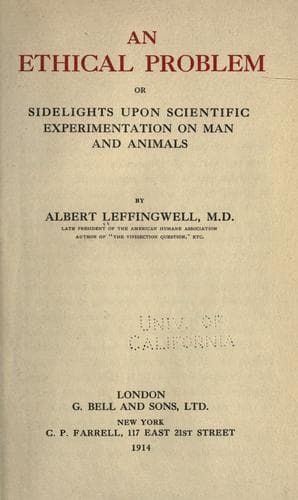
An ethical problem; or, Sidelights upon scientific experimentation on man and animalsLeffingwell, Albert
Philosophy
An ethical problem; or, Sidelights upon scientific experimentation on man and animals
Leffingwell, Albert
Medicine, Experimental; Vivisection
Philadelphia is not to be determined by that of one of its slum
districts. If, a century ago, a slave-owner of Jamaica owning ten
negroes, whipped one of them so severely that he died, should we be
justified in declaring that in the West Indies the murder-rate of
slaves was 10 per cent., or "ten in a hundred"? Its absurdity is
manifest. When, therefore, a reputable writer for a magazine largely
read by wives and mothers puts forth the statement that by reason of
some experiments the death-rate of diseases incident to maternity has
been reduced "from ten or more mothers out of every hundred," leaving
it to be inferred that such rate of mortality was once general, what
are we to infer concerning his ideals of scientific accuracy?
[1] "Medical Essays of Dr. O. W. Holmes," Boston, 1899, p. 156.
[2] "Polk told us that when he graduated in medicine, delivery in a
lying-in hospital was far more dangerous than an engagement in the
bloodiest battle, for during his internship at Bellevue, he saw FORTY-
FIVE WOMEN DIE OUT OF THE SIXTY WHO HAD BEEN DELIVERED DURING A SINGLE
MONTH."--Williams; Jour. Am. Med. Association, June 6, 1914.
Equally mistaken is the implication conveyed by the passage quoted
that some vast reduction of mortality has been accomplished in regard
to this special form of disease. This belief is doubtless entertained
by a majority of medical practitioners, accustomed to accept
statements of leaders without investigation or questioning. But it is
not true. We need to remember, as Dr. Oliver Wendell Holmes tells us,
"how kindly Nature deals with the parturient female, when she is not
immersed in the virulent atmosphere of an impure lying-in hospital."
To demonstrate the exact facts, I have tabulated all the deaths in
England and Wales from diseases incident to child-birth, as compared
with the number of children born, for sixty years from 1851 down to
1910. It will probably surprise many a medical practitioner to know
that so far from having vastly diminished, the death-rate from
diseases of this character in England and Wales WAS ACTUALLY LESS HALF
A CENTURY AGO THAN IT WAS DURING THE TEN YEARS ENDING 1910. But the
facts are beyond question; they not only rest upon the official
reports of the Registrar-General, but they show a uniformity year
after year which it is impossible to regard as due to chance. In
England and Wales, during twenty years (1851-1870) the total number of
births reported by the Registrar-General was 13,971,746. The total
deaths from puerperal fever during the same period were 21,935--a
mortality-rate per 100,000 births of 157. This was the period between
forty and sixty years ago. During the ten years between 1901 and
1910, the births in England and Wales numbered 9,208,209; and the
deaths from puerperal sepsis were 16,341, a mortality-rate per 100,000
births of 175--GREATER THAN THAT OF HALF A CENTURY AGO! The mortality-
rate may now be going downward; it was in 1910 but 142 per 100,000
Public-domain text, read in full here on John Shaqi.
Reviews
Reviews
No reviews yet
Be the first to share your thoughts on this work.
Elsewhere in the archive
Join the Discussion
Join the discussion
Sign in to leave a comment or review.
Sign InorCreate an account