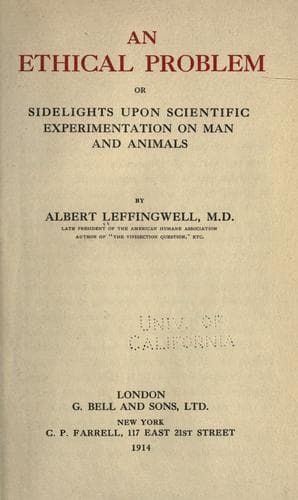
An ethical problem; or, Sidelights upon scientific experimentation on man and animalsLeffingwell, Albert
Philosophy
An ethical problem; or, Sidelights upon scientific experimentation on man and animals
Leffingwell, Albert
Medicine, Experimental; Vivisection
Why does it seem worth while to dwell upon these exaggerations and
untruths? Was it necessary to go through the mortality records of a
nation for more than half a century merely to prove the falsity of a
single laboratory claim? I think so. These are not ordinary blunders
or trivial mistakes. They are affirmations made in opposition to the
slightest step toward reform of great abuses, by honoured and
distinguished writers; by men who are regarded as absolutely reliable
in all statements of fact. Their assertions of the vast benefits
conferred upon the human race by experiments upon living animals are
made in the journals of the day, in popular magazines--in periodicals
which refuse opportunity of rejoinder, and which therefore lend their
influence to securing the permanency of untruth. There are problems
of science concerning which such affirmations would be of
comparatively little consequence; if they concerned, for example the
weight of an atom or the distance of a star, the controversy would
excite but a languid interest, and the correction of inaccuracy might
safely be left to time. But here, on the contrary, we touch some of
the most vital problems of life and death, problems that concern every
one; and in defence of practices, the cruelty of which has been
challenged as abhorrent to the conscience of mankind, we have
distorted and exaggerated claims of utility; we have assertions that
have no basis in fact; we have covert appeals to woman's fears in her
greatest emergency, and to that sentiment, the noblest almost that man
himself can entertain--his solicitude for the mother of his children
in her hour of peril. To the malign influence of untrue suggestion no
bounds can be placed; in the creation of a public sentiment, its
influence extends in ever-widening circles. It is against this
unfairness and exaggeration that those who take moderate ground in
this question of animal experimentation have the duty of protest and
complaint. We do not ascribe the unfairness to intentional
mendacity. Such motive may be discarded without hesitancy, so far as
concerns any reputable writer. But surely there has been a
carelessness regarding the truth which even the plea of ignorance
ought not wholly to condone.
And the lesson? It is the reasonableness of doubt. Every statement
put forth by the Laboratory interests in defence of the present system
of unrestricted and secret vivisection should be regarded with
scepticism unless accompanied by absolute proofs. In an experience of
more than a third of a century, I have never read a defence of
vivisection without limitations, which did not contain some
exaggerated claim, some misstatement of fact. To doubt is not to
dishonour; it is the highest tribute we may pay to Science; for
"without doubt, there is no inquiry, and without inquiry, no
knowledge."
CHAPTER XVI
RESEARCH WITHOUT VIVISECTION
Public-domain text, read in full here on John Shaqi.
Reviews
Reviews
No reviews yet
Be the first to share your thoughts on this work.
Elsewhere in the archive
Join the Discussion
Join the discussion
Sign in to leave a comment or review.
Sign InorCreate an account