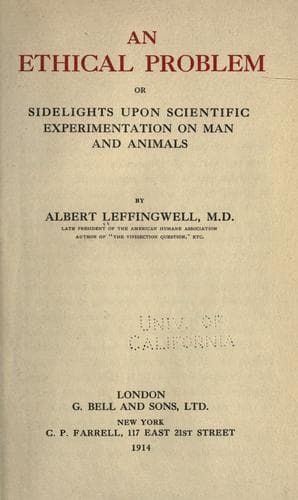
An ethical problem; or, Sidelights upon scientific experimentation on man and animalsLeffingwell, Albert
Philosophy
An ethical problem; or, Sidelights upon scientific experimentation on man and animals
Leffingwell, Albert
Medicine, Experimental; Vivisection
In another work I have ventured to suggest that if we are to discover
the cause of cancer, we must study the habits and customs of those
still living who have become the victims of some form of this
mysterious disease. A theory held by some is that cancer is due to
the consumption of meat. If one means that the flesh of perfectly
healthy animals is liable to cause cancer, the hypothesis is one for
which it seems to me that the evidence is far from being sufficient to
justify belief. But if, on the other hand, it is suggested that
malignant disease may be due to germs derived from animals which were
suffering from som form of cancer when they were killed for the food
of human beings, then much that is otherwise obscure becomes plain.
We should expect in such cases to find cancer more prevalent among the
poor than among the rich, and especially prevalent among those who,
from carelessness, or ignorance, or seeming necessity, consume the
cheaper kinds of meat. And since, both in their native land and in
America, the Italian population consumes less meat than peoples of
other nationalities, we should expect them to be less liable to be
infected by the germs of malignant disease.
A few years ago a medical writer who has given much attention to this
disease published some of his investigations into the cancer
death-rate of Chicago. Taking the figures for a single year, he
discovered that the "cancer death-rate among the Irish and German
residents of Chicago is the highest in the world, being nearly 300 per
cent. higher than in their native countries."[1] Of each 10,000
population of each nationality living at the age of forty years and
over, he found that the deaths from cancer among the Germans was 76,
among the Irish 70, among the Scandinavians 52, and among the natives
of Italy 24. It was found that, while the staple diet of Italians in
Chicago was macaroni and spaghetti, the people of other nationalities
among whom the cancer-rate was exceedingly high, "consume large
quantities of canned and preserved meats and sausages, OFTEN EATEN
UNCOOKED." He discovered that a large part of the fresh meat prepared
at the establishment of a certain slaughtering establishment in
Chicago was derived from animals which had been condemned on the ante-
mortem inspection, but the flesh of which was perimitted TO BE SOLD AS
PURE FOOD AFTER THE DISEASED PARTS HAD BEEN REMOVED. Sold thus at a
cheaper price, such meat was chiefly consumed by the poorer classes of
the foreign population. And while Dr. Adams does not adopt the
hypothesis of the cancer-germ, he does not think there can be "the
slightest question but that the increase in cancer among the foreign-
born over the prevalence of that disease in their native countries is
due to the increased consumption of animal foods, PARTICULARLY THOSE
DERIVED FROM DISEASED ANIMALS."
[1] See article by Dr. G. Cooke Adams in Chicago Clinic of August,
1907, pp. 248-251.
Public-domain text, read in full here on John Shaqi.
Reviews
Reviews
No reviews yet
Be the first to share your thoughts on this work.
Elsewhere in the archive
Join the Discussion
Join the discussion
Sign in to leave a comment or review.
Sign InorCreate an account