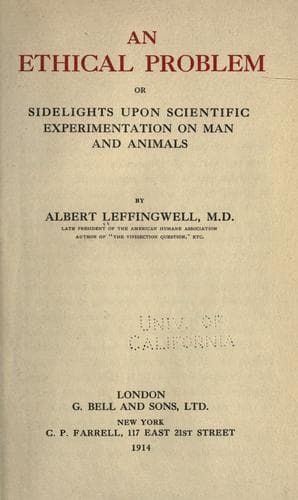
An ethical problem; or, Sidelights upon scientific experimentation on man and animalsLeffingwell, Albert
Philosophy
An ethical problem; or, Sidelights upon scientific experimentation on man and animals
Leffingwell, Albert
Medicine, Experimental; Vivisection
SECOND. What is the location of the suspected ailment? When were the
first symptoms manifested? To what cause, if any, were they ascribed?
Has any surgical operation been performed, and if so, what are the
details of time and place? Has recurrence followed operation? For what
period was there freedom from symptoms?
Whatis the social position of the patient? Does he belong to that
class which is enabled always to select the best food, the most
sanitary dwellings, and all the conveniences of well-ordered and
comfortable existence; or, on the other hand, to the extremely poor
class, which disregards cleanliness, indulges to excess in the use of
stimulants, and consumes the poorest and cheapest kinds of meat? I
deem it of great importance that the completest possible information
be secured concerning the usual diet of every sufferer from this
disease. Is he a vegetarian? Are viands invariably well-cooked, or
eaten sometimes rare or raw? Is there a liking for the canned products
of the packing-house, or for sausage that comes from the same
source?[1] What is the water-supply? Within the knowledge of the
patient or friends, has there been any other case of malignant disease
in the same house? Is residence near any fresh-water lake or stream?
[1] The relation between diseased meat and human ailments is treated
at length in my work on "American Meat," New York, 1909.
These are suggestions only. They constitute merely an outline of the
information that is necessary, concerning the living sufferers, in
whom the disease has made its appearance. Doubtless the average
reader will discern no reason for all these inquiiries. Yet each one
has some pertinency to the possible discovery of the great secret.
Does inquiry concerning family history seem useless? It should have a
decided bearing on any theory of heredity. Does the occurrence of
near-by cases have no significance? We are not yet in a position to
state this as a fact. Does inquiry concerning religion seem
especially impertinent? What if some future investigation should prove
that cancer everywhere, is more prevalent among the Christians than
the Jews? Does the social condition of the sufferer seem to have no
relation to cause? What if we discover, that everywhere,--and not
among the foreign population of Chicago only,--cancer finds an undue
proportion of its victims among the poorest and most poverty-stricken
element of every nationality? Does suggestion of inquiry concerning
diet induce a smile? It should not, as long as meat derived from
cancerous animals is permitted by Government authority, to pass
inspection, and to be distributed throughout the world. And no
inquiry concerning cancer can be deemed complete which has not fully
investigated the extent to which this atrocious practice has been
carried on for the past quarter of a century.
Public-domain text, read in full here on John Shaqi.
Reviews
Reviews
No reviews yet
Be the first to share your thoughts on this work.
Elsewhere in the archive
Join the Discussion
Join the discussion
Sign in to leave a comment or review.
Sign InorCreate an account