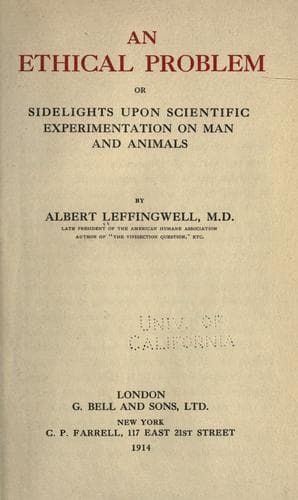
An ethical problem; or, Sidelights upon scientific experimentation on man and animalsLeffingwell, Albert
Philosophy
An ethical problem; or, Sidelights upon scientific experimentation on man and animals
Leffingwell, Albert
Medicine, Experimental; Vivisection
It seems to me probable, therefore, that for many years to come, the
laboratory for vivisection, IF ONLY IT CAN MAINTAIN ITS SECRECY, will
continue as serenely indifferent to criticsm, as completely master of
the confidence of modern society, as supreme in power and position as
was the Spanish Inquisition of three centuries ago. New laboratories
will be founded upon ill-gotten wealth; new inquisitors, with salaries
greater than those of Washington or Lincoln will take the places of
those that retire; new theories, now unimagined, will demand their
tribute of victims to help prove or disprove some useless hypothesis;
even new methods of torment may be invented, and new excuses for their
necessity put forth. Nor is this all. If the laboratory of the
present day shall continue to maintain its hold upon the intelligence
of modern society; if it can keep unimpaired that confidence in its
benevolent purpose, that belief in accomplishment, that faith in
utility which now so largely obtains; and if, moreover, it can secure
for the charity hospital that absolute power and secrecy which it has
gained for itself in animal experimentation, then, within the lifetime
of men now living, human beings will take their place as "material"
for investigation of human ailments. Upon the living bodies of
Amerian soldiers, upon lunatics in asylums and babes in institutions
and patients in charity hospitals, experiments of this character have
already taken place. Is utility to Science to be considered the
standard by which human actions are to be judged? Then, even within
the present century, experimentation upon human beings may be openly
acknowledged as a defensible method of investigation.
Now all this is not a cry of despair, a confession of defeat. It is
meant only to be rational recognition of existing conditions, and
especially of the forces that now prevent reform. Perhaps if the
armies were united, a different forecast could be made; but that union
is beyond hope. The enthusiasm that would expect to eliminate a great
evil on other terms, and within the space of time occupied by a single
generation does not seem to me to be justified by the records of
history. Of the ultimate triumph of the reform of vivisection, there
can be no more question than of the result of the agitation against
human slavery, against the torment of criminals, against the burning
of the heretic or the witch. In what way may we anticipate its
coming?
Public-domain text, read in full here on John Shaqi.
Reviews
Reviews
No reviews yet
Be the first to share your thoughts on this work.
Elsewhere in the archive
Join the Discussion
Join the discussion
Sign in to leave a comment or review.
Sign InorCreate an account