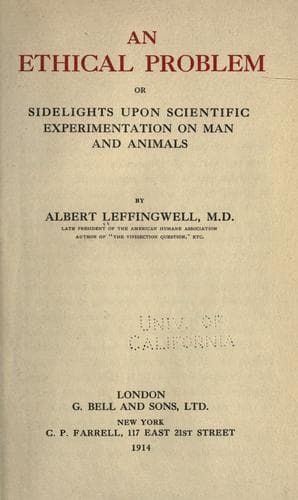
An ethical problem; or, Sidelights upon scientific experimentation on man and animalsLeffingwell, Albert
Philosophy
An ethical problem; or, Sidelights upon scientific experimentation on man and animals
Leffingwell, Albert
Medicine, Experimental; Vivisection
We are living to-day in a period of unrest and change, such as the
world has never known before. A new social consciousness has awakened
throughout the civilized world, a feeling that for those who are to
come after us, life should be happier and better than it is. Humanity
is advancing toward its ideals by leaps and bounds, where once it
slowly crept. Every social problem, from the prevention of cruelty,
the suppression of vice, the rescue of the submerged, to the abolition
of poverty itself, is to-day more in the thought of humanity than ever
before in the history of the world. We are but just beginning to
learn our duties to human beings of other races; may we not be assured
that the more sensitive conscience of the future will define with
authority, our duties to the humbler sharers of this mysterious gift
of life? Already, Science has told us, that far in the past, we had
the same origin; and surely, when some higher ideal than utility to
ourselves, shall dominate human conduct, there will be a new
conception of JUSTICE toward every sentient being. It may mean
extinction of species; but it will notmean their torment. You and I
cannot hope for life long enough to see the realization of that
dream. And yet, sometimes I have wondered whether it be so far
distant as I have feared. But a little while ago, who of us could
have imagined that in our day, the Government of the United States
would listen to the cries of little birds, starving on their nests in
the swamps of Florida, and prohibit the importation of the egret
plumes? How much of hopefulness for the final triumph of th
eprinciples of humaneness lies in the passage of such a law!
I fancy that one day, all noxious animals, and especially those which
prery upon other creatures, will largely, if not entirely, disappear.
It is calculated that ever grown lion in South Africa kills for food,
every year, between 200 and 300 harmless animals, and each one of
which is as much entitled as the lion to the happiness of existence.
In great museums to-day, we see the remains of creatures, like the
sabre-toothed tiger, that lived probably, over a million years ago.
In a century or two, hence, the skeletons of the panther, the tiger,
the leopard and the lion, will be found in the same halls of science,
with those of other extinct species, that could exist only at the
expense of others' lives.
Public-domain text, read in full here on John Shaqi.
Reviews
Reviews
No reviews yet
Be the first to share your thoughts on this work.
Elsewhere in the archive
Join the Discussion
Join the discussion
Sign in to leave a comment or review.
Sign InorCreate an account