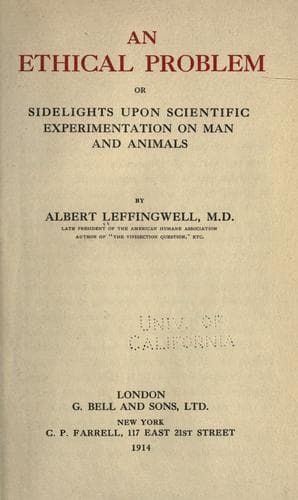
An ethical problem; or, Sidelights upon scientific experimentation on man and animalsLeffingwell, Albert
Philosophy
An ethical problem; or, Sidelights upon scientific experimentation on man and animals
Leffingwell, Albert
Medicine, Experimental; Vivisection
On March 3, 1905, a young German biologist by the name of Schaudinn
discovered under the microscope what is now generally believed to be
the germ of this terrible disease. It is a minute, spiral-shaped
organism, with six or eight curves, and capable of movement in space.
Its place in the scheme of existence is not wholly certain, but the
probability seems that it is a protozoan, belonging to the lowest form
of animal life. Its very simplicity makes it appalling; we do not
understand how anything so innocent in appearance, can occasion such
terrible ravages. In the course of the evolution of life how came it
into being? We can only surmise. But once having gained a foothold in
the body of a human being, the minute organism begins to multiply: and
penetrating to any part of the body, it induces the ravages of a
destroyer espite all the opposing defences which Nature may raise
against it. The discoverer first called it the "Spirochaete
pallidum," but later invented a new name--"Treponema pallidum"--by
which it is at present generally known. It is almost ceratin that in
this minute organism, invisible to the naked eye, we have the
causative agent of one of the great destroyers of the human race.
A Japanese physician, connected with various phases of research work
in the Rockefeller Institute (Dr. Hideyo Noguchi), believed it would
be possible to device a method for detecting the existence of these
germs of syphilis in certain latent and obscure cases, where the
disease was merely suspected. He had no though of inventing a cure
for the disease; it was a method of detection only. By ingenious
procedures which it is unnecessary here to describe, Dr. Noguchi
succeeded in cultivating these germs OUTSIDE THE HUMAN BODY; and after
grinding them in a sterile mortar, and subjecting them to heat with
other manipulations, he found himself finally in possession of an
extract or emulsion to which he gave the name of "luetin." It contains
the germs of syphilis; but they are intended to be DEAD GERMS. The
experimenter himself says:
"I have proposed the name LUETIN for an emulsion or extract of pure
culture of Treponema pallidum, which is designed to be employed for
obtaining in suitable cases, a specific cutaneous reaction that may
become a valuable diagnostic sign in certain stages or forms of
syphilitic infection."
Public-domain text, read in full here on John Shaqi.
Reviews
Reviews
No reviews yet
Be the first to share your thoughts on this work.
Elsewhere in the archive
Join the Discussion
Join the discussion
Sign in to leave a comment or review.
Sign InorCreate an account