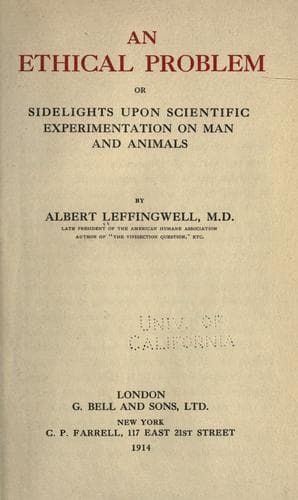
An ethical problem; or, Sidelights upon scientific experimentation on man and animalsLeffingwell, Albert
Philosophy
An ethical problem; or, Sidelights upon scientific experimentation on man and animals
Leffingwell, Albert
Medicine, Experimental; Vivisection
Attention has been called, in the preceding pages, to many statements,
which a close examination would seem to prove to be misleading and
inaccurate. But every discerning reader should recognize that
inaccuracy or untruth does not imply the moral obliquity that pertains
to intentional falsehood. An experimenter, for example, makes an
assertion regarding the absolute painlessness of his vivisections.
Such statement may be demonstrated, let us say, to be exceedingly
doubtful, if not quite untrue. That is as far as legitimate criticism
can easily go. It is quite impossible to demonstrate a conscious
intent to deceive. To interpret motives, to impute falsehood is to go
beyond facts into regions where facts are not to be found, except in
exceedingly exceptional cases. One of thet Royal Commissioners
expressed this position very clearly. "While I feel bound," wrote
Dr. George Wilson, "to accept the assurances of all the expert
witnesses who appeared before us, as assurances of their honest
conviction that vivisectional or cutting experiments can be, and are
carried out without the infliction of pain from the moment the first
wound is made, ... I can only accept them AS OPINIONS, to which the
greatest weight should be attached, AND NOT AS STATEMENTS OF ABSOLUTE
FACT so far as specific instances are concerned." This is exactly the
attitude for any critic of vivisection to take. A distinguished
physician, testifying before the Commissioners, declared that it was
entirely possible to keep a dog in a state of anaesthesia for a week,
if necessary. Experimentation in this direction, in all probability
would prove the assertion to be untrue, but although such
demonstration would be proof of inaccuracy and carelessness, it could
not justify, in any way, the charge of dishonourable motives. In no
instance, therefore, in the illustrations of inaccuracy given in the
preceding pages, is there any imputation of perverse and intentional
inveracity.
Public-domain text, read in full here on John Shaqi.
Reviews
Reviews
No reviews yet
Be the first to share your thoughts on this work.
Elsewhere in the archive
Join the Discussion
Join the discussion
Sign in to leave a comment or review.
Sign InorCreate an account