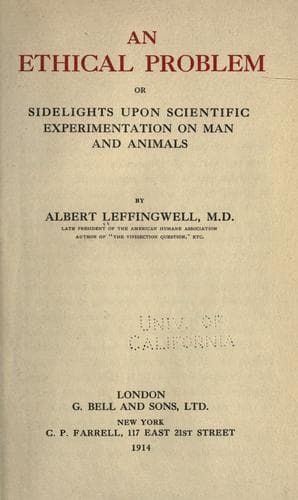
An ethical problem; or, Sidelights upon scientific experimentation on man and animalsLeffingwell, Albert
Philosophy
An ethical problem; or, Sidelights upon scientific experimentation on man and animals
Leffingwell, Albert
Medicine, Experimental; Vivisection
"But all real progress in civilization depends upon man's ethical
ideals.... What shape and tendency are these hopes and ambitions to
assume in coming years? What are the ideals held up before American
students in American colleges? What are the names whose mention is to
fire youth with enthusiasm, with longing for like achievement and
similar success? Is it Richet, `bending over palpitating entrails,
surrounded by groaning creatures,' not, as he tells us, with any
thought of benefit to mankind, but simply `to seek out a new fact, to
verify a disputed point?' Is it Mantegazza, watching day by day, `con
multo amore e patience moltissima,'--with much patience and pleasure--
the agonies of his crucified animals? Is it Brown-Sequard, ending a
long life devoted to the torment of living things with the investion
of a nostrum that earned him nothing but contempt? Is it Goltz of
Strasburg, noting with wonder that mother love and yearning solicitude
could be shown even by a dying animal, whose breasts he had cut off,
and whose spinal cord he had severed? Is it Magendie, operating for
cataract and plunging the needle to the bottom of the patient's eye,
that by experiment upon a human being he might see the effect of
irritating the retina? ... Surely, in these names, and such as these,
there can be no uplift or inspiration to young men toward that
unselfish service and earnest work which alone shall help toward the
amelioration of the world."
In this passage, there is an allusion of JUST SIX WORDS to one phase
of experimentation which was subsequently found to be inaccurate, and
corrected, as Dr. Keen has shown. But was it in accord with truth to
refer to this passing reference as "A DESCRIPTION of the same
operation"? No reader of Dr. Keen's pages would be likely to
investigate the statement. Was it fair to permit his readers to
understand that a DESCRIPTION EXISTED, WHERE THERE WAS NONE?
There is yet another point to be noted. Referring to the experiments
of Goltz, the impression seems to be given that not only was ablation
of the breast mistakenly ascribed to the Strasburg vivisector, but
that such a vivisection was imaginary: "NO SUCH OPERATION WAS EVER
DONE." This is also untrue. Experiments of the kind have been done by
other vivisectors, and they are recorded in their own reports. For
example, de Sinety of Paris tells us in his "Manuel Pratique de
Gynecologie" (Paris, 1879, p. 778), that upon female guinea-pigs, he
had practised "l'ablation de ces glands pendant la lactation."[1]
Another French vivisector, Dr. Paul Bert, states that he had not only
performed "l'ablation des mamelles chez une femelle de cochon d'Inde,"
but that he had succeeded in performing the operation on a female
goat. The poor creature recovered from the vivisection, and later,
gave birth to a kid, which was placed with the mother. What would
happen to a new-born animal placed at the side of a mother whose
breasts had been cut off?
Public-domain text, read in full here on John Shaqi.
Reviews
Reviews
No reviews yet
Be the first to share your thoughts on this work.
Elsewhere in the archive
Join the Discussion
Join the discussion
Sign in to leave a comment or review.
Sign InorCreate an account