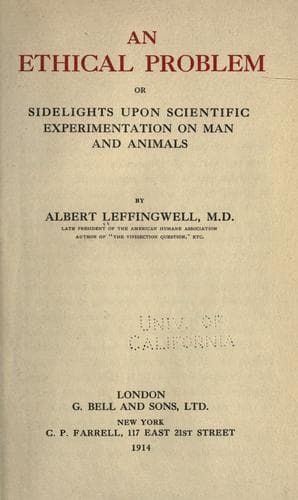
An ethical problem; or, Sidelights upon scientific experimentation on man and animalsLeffingwell, Albert
Philosophy
An ethical problem; or, Sidelights upon scientific experimentation on man and animals
Leffingwell, Albert
Medicine, Experimental; Vivisection
In Science, there is no one method that can be considered
indispensable. Attributes are indispensable; observation, industry,
accuracy are indispensable; methods are not. Methods may be
convenient, they may be useful, they may be expedient, but nothing
more. Celsus tells us that Erasistratus and the school he founded
laid open the bodies of criminals in order to study by direct
observation, the action of the intestinal organs during existence.
The act at that date of civilization probably shocked no one; it was
no doubt in accord with the spirit of the time. In a day not very
remote from our own, a criminal sentenced to death for some trivial
crime, was given over to William Cheselden, surgeon to George the
First, for experiment. The criminal was deaf and the experiment
intended was that of making a puncture through the drum of the ear, in
order to discover if an opening through the drum would enable the deaf
to hear. At the last moment, Cheselden, a man of fine feeling, and
brilliant as an operating surgeon, declined the experiment, on which
the criminal, whose life had been conditionally spared, was set free.
For his generosity of mind, for shrinking from an experiment on
another human being, Cheselden lost caste at Court, and was considered
pitiable by those who lived on courtly favours.
The argument is taking now the same direction against experiments by
man conducted on the lower animals for the purposes of discovery; and
when from the history of the past we gather what has been achieved by
such experiments, there is but one answer--namely: that such
experiments, although they may achieve what was expected of them, were
not indispensable. They may have expedited discovery; they may have
led to discovery; but they were not indispensable.
---------------------
In the discovery of anaesthesia, general and local, painful experiment
on animals has played no indispensable part whatever.
The lower animals have been permitted to share, more than equally with
man, in the blessing of anaesthetic discovery, for by it, many of them
have been saved the agonies of painful death, but they have (not) been
subjected to painful experiment in the course of discovery.... The
instauration of general anaesthesia came from experiments made on man
alone. There is no suspicion of any experiment on a lower animal in
connection with it.... On the contrary, there is a most notable fact
in relation to experiments under chloroform made on lower animals,
which suggests that if they had ever been relied on,--chloroform would
never have been introduced into practice. Flourens, the eminent
French physiologist, tried the effect of chloroform on inferior
animals, and in consequence of its powerful and fatal influence on
them, put it aside as an anaesthetic.
---------------------
There are methods of producing local insensibility to pain which have
been tried, and which deserve notice.
Public-domain text, read in full here on John Shaqi.
Reviews
Reviews
No reviews yet
Be the first to share your thoughts on this work.
Elsewhere in the archive
Join the Discussion
Join the discussion
Sign in to leave a comment or review.
Sign InorCreate an account