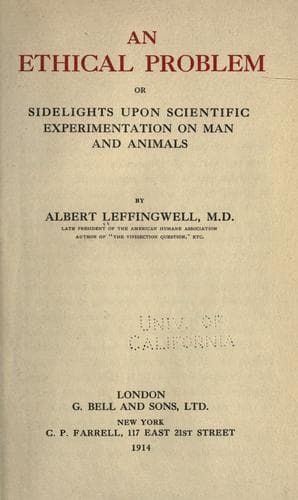
An ethical problem; or, Sidelights upon scientific experimentation on man and animalsLeffingwell, Albert
Philosophy
An ethical problem; or, Sidelights upon scientific experimentation on man and animals
Leffingwell, Albert
Medicine, Experimental; Vivisection
---------------------
There are some simple and painless experiments which may be
demonstrated to any set of pupils, although living animals are the
subjects of them. The demonstration of the circulation through the
web of the frog; the demonstration of the different natural
temperatures of the bodies of animals, including man; the influence of
various anaesthetic vapours; the collection of the breath of various
animals for the purpose of analysis,--these are all free from
objection.... In a word, all experiments which are painless and
harmless, are, as I assume the most humane would admit, free from any
charge of error. But when we come to consider the application of
experiment of a severe kind as a means of education of pupils who are
making a study of physiological problems, there is a reason for
hesitation. In my student days, such an experiment was never dreamed
of. The professor of physiology would relate the facts derived from
experiment, on which some important theories were founded; he would,
for instance, explain what experiments were made by Harvey in order to
describe the circulation of the blood, but he would not attempt to
repeat those experiments in the lecture-room. He would describe, in
his remarks on the functions of the nervous system, the researches of
Sir Charles Bell, ... but he would never think of repeating Bell's
experiment of division of the nerves in the column, alleging forcibly
Bell's own objection to its repetition. It was the same on every
point. He would relate the theory; relate the pros and cons; relate
possibly his own independent inquiries, or what he had seen
experimentally performed by other independent investigators; but with
that explanation, he would be content.
---------------------
When I was teaching physiology as I did teach it in a medical school
for many years, I abstained for a long period from the direct
experimental method. I found no difficulty, and my classes worked
satisfactorily. The students had the credit of becoming good
physiologists, and I am sure there was nothing shirked. In the latter
part of my time, I followed occasionally the plan of making a few
experiments in the way of demonstration; and although these were
rendered painless, the innovation was not the success that was
expected.... Intellectually, I do not think my classes were assisted,
in the main, by the experimental demonstration. I am sure it limited
my sphere of usefulness, by leading me, in the limited time at my
command, to omit some parts of physiology of a simpler, less
controversial, and more useful kind. I am bound to say that, morally,
I do not recall the effect as producing all that could be wished.... I
gave up experiments in my classes, not from any sentiment, but BECAUSE
I GOT ON BETTER WITHOUT THEM. I did not omit the facts derived from
experiment, I did not omit the report of my own experimental
Public-domain text, read in full here on John Shaqi.
Reviews
Reviews
No reviews yet
Be the first to share your thoughts on this work.
Elsewhere in the archive
Join the Discussion
Join the discussion
Sign in to leave a comment or review.
Sign InorCreate an account