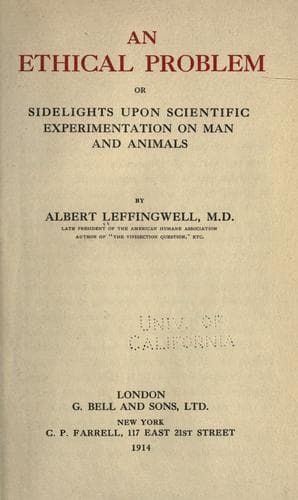
An ethical problem; or, Sidelights upon scientific experimentation on man and animalsLeffingwell, Albert
Philosophy
An ethical problem; or, Sidelights upon scientific experimentation on man and animals
Leffingwell, Albert
Medicine, Experimental; Vivisection
To the London Lancet the cause of humaneness to animals is also
indebted, for its repeated condemnation of the cruelties of
vivisection. As the exponent and representative of British surgery,
its words undoubtedly carried great weight among medical
practitioners. In its issue of August 11, 1860, after pointing out
the utility of certain physiological inquiries, the Lancet's editor
thus defines what it regards as reprehensible cruelty:
"On the other hand, when at any moment the practice overpasses the
rigorous bounds of utility, when its object is no longer the pursuit
of new solutions of scientific problems, or the examination of
hypotheses requiring a test; when vivisection is elevated into an art,
and this art becomes a matter of public demonstration--then it is
degraded by the absence of a beneficent end, and becomes a cruelty.
The THE EXHIBITIONS OF EXPERIMENTS WHICH AIM ONLY AT A REPETITION OF
INQUIRIES ALREADY SATISFACTORILY CONCLUDED, and the DEMONSTRATION OF
FUNCTIONS ALREADY UNDERSTOOD, appear to us to rank among the excesses
which must be deplored, if not repressed. The displays in these
amphitheatres are of the most painful kind, and it is to be deeply
regretted that curiosity should silence feeling, and draw spectators to
mortal suffering.... The Commission (of the Societies for Prevention
of Cruelty) asks for nothing which the most zealous devotees of
science cannot--and ought not--to grant. It demands only the
cessation of experiments which are PURELY REPETITIVE DEMONSTRATIONS OF
KNOWN FACTS."
This is a remarkable utterance. It is quite probable that it voiced
an almost unanimous opinion among English physicians and surgeons of
half a century ago. How far have we strayed since then! The Lancet of
to-day would doubtless earnestly oppose any legal prohibition of
experiments which it once ranked among the "excesses which must be
deplored, IF NOT REPRESSED."
Two or three months afterward the Lancet again expressed its
condemnation of experiments made for the demonstration of known
facts. In its issue of October 20, 1860, the Lancet editor says:
"The moment that it [vivisection] overpasses the bounds of necessity;
when it ceases to aim at the solution of problems in which humanity is
interested, and becomes a new means of public demonstration, having no
benevolent end--then it is degraded to the level of A PURPOSELESS
CRUELTY. The repetitive demonstration of known facts, by public or
private vivisections, is an abuse that we deplore, and have more than
once condemned."
On January 12, 1861, the Lancet opens its columns to a correspondent,
who invites attention of its readers to the views of Professor Owen,
afterward Sir Richard Owen, and the most distinguished anatomist of
his time:
Public-domain text, read in full here on John Shaqi.
Reviews
Reviews
No reviews yet
Be the first to share your thoughts on this work.
Join the Discussion
Join the discussion
Sign in to leave a comment or review.
Sign InorCreate an account