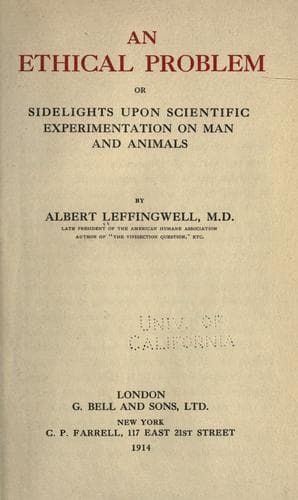
An ethical problem; or, Sidelights upon scientific experimentation on man and animalsLeffingwell, Albert
Philosophy
An ethical problem; or, Sidelights upon scientific experimentation on man and animals
Leffingwell, Albert
Medicine, Experimental; Vivisection
"Professor Owen, one of the first physiological authorities of the
present day, observes: `That no teacher of physiology is justified in
repeating any vivisectional experiment, merely to show its known
results to his class or to others. IT IS THE PRACTICE OF VIVISECTION,
in place of physiological induction, pursued for the same end, AGAINST
WHICH HUMANITY, CHRISTIANITY, AND CIVILIZATION SHOULD ALIKE PROTEST.'"
It is probable that no stronger denunciation of the cruelty of
vivisection ever appeared than that contained in the leading editorial
of the London Lancet of August 22, 1863. The writer was certainly not
an opponent of all experiments upon animals; he admits that "if
pressed for a categoric answer whether such a practice as vivisection
were permissible under proper restrictions for the purpose of
advancing science and lessening human suffering, the answer would be
in the affirmative." But the practice is evidently spreading. It is
asserted that experiments upon animals "are a common mode of lecture
illustration," and that such investigations "have spread from the hand
of the retired and sober man of matured science into those of everyday
lecturers and their pupils." Against such extension of vivisection the
editor of the Lancet enters an emphatic protest:
"If we were pressed simply for a categoric answer to the question
whether such a practice [as vivisection] were permissible under proper
restrictions and for the purpose of advancing science and lessening
human suffering, we need hardly say that the answer would be in the
affirmative. It is asserted, however, that the practice of
vivisection and such investigations as are implied by this term, `have
spread from the hands of the retired and sober man of matured science
into those of everyday lecturers and their pupils,' and that such
experiments `are a common mode of lecture illustration....'
"We will state our belief that there is too much of it everywhere, and
that there are daily occurring practices in the schools of France
which cry aloud in the name both of honour and humanity for their
immediate cessation. About two years ago, our Royal Society for
Prevention of Cruelty to Animals became possessed of the knowledge
that it was still the practice in the schools of Anatomy and
Physiology in France for lecturers and demonstrators to tie down cats,
dogs, rabbits, etc., before the class; to perform upon them operations
of great pain, and to pursue investigations accompanied by the most
terrible torture. THIS, TOO, FOR THE PURPOSE ONLY OF DEMONSTRATING
CERTAIN FACTS WHICH HAD BEEN FOR LONG UNHESITATINGLY ADMITTED, and
for giving a sort of meretricious air to a popular series of lectures.
It learned, moreover, that at the veterinary schools of Lyons and
Alfort, live horses were periodically given up to a group of students
for anatomical and surgical purposes, often exercised with ... extra
refinements of cruelty...."
Public-domain text, read in full here on John Shaqi.
Reviews
Reviews
No reviews yet
Be the first to share your thoughts on this work.
Join the Discussion
Join the discussion
Sign in to leave a comment or review.
Sign InorCreate an account